Blind Americans Equality Day
Saturday, October 15, 2022
Saturday, October 15, 2022
Blind Americans Equality Day, formerly known as White Cane Awareness Day, is celebrated every year on October 15 to highlight the challenges faced by people who are blind and provide resources to empower them. In the 1960s, the National Federation of the Blind became a leader in fighting for the rights of the blind and in pioneering innovative training programs using the white cane. White canes represent the independence of blind people throughout the world and are used in a variety of ways. White canes help enhance the sense of touch, making it easier to recognize steps, uneven pavement, and hazards.
As a result of the National Federation of the Blind’s persistence in fighting for the rights of people who are blind, the United States Congress passed a law authorizing the president to proclaim October 6th as White Cane Safety Day. On October 15, 1964, President Lyndon B. Johnson signed the first proclamation for White Cane Safety Day recognizing the role that white canes play in enabling blind people to travel independently and safely. In 2011, President Barack Obama renamed it “Blind Americans Equality Day” to reflect its significance and called on “all public officials, business and community leaders, educators, librarians, and Americans to observe this day with appropriate ceremonies, activities, and programs.”
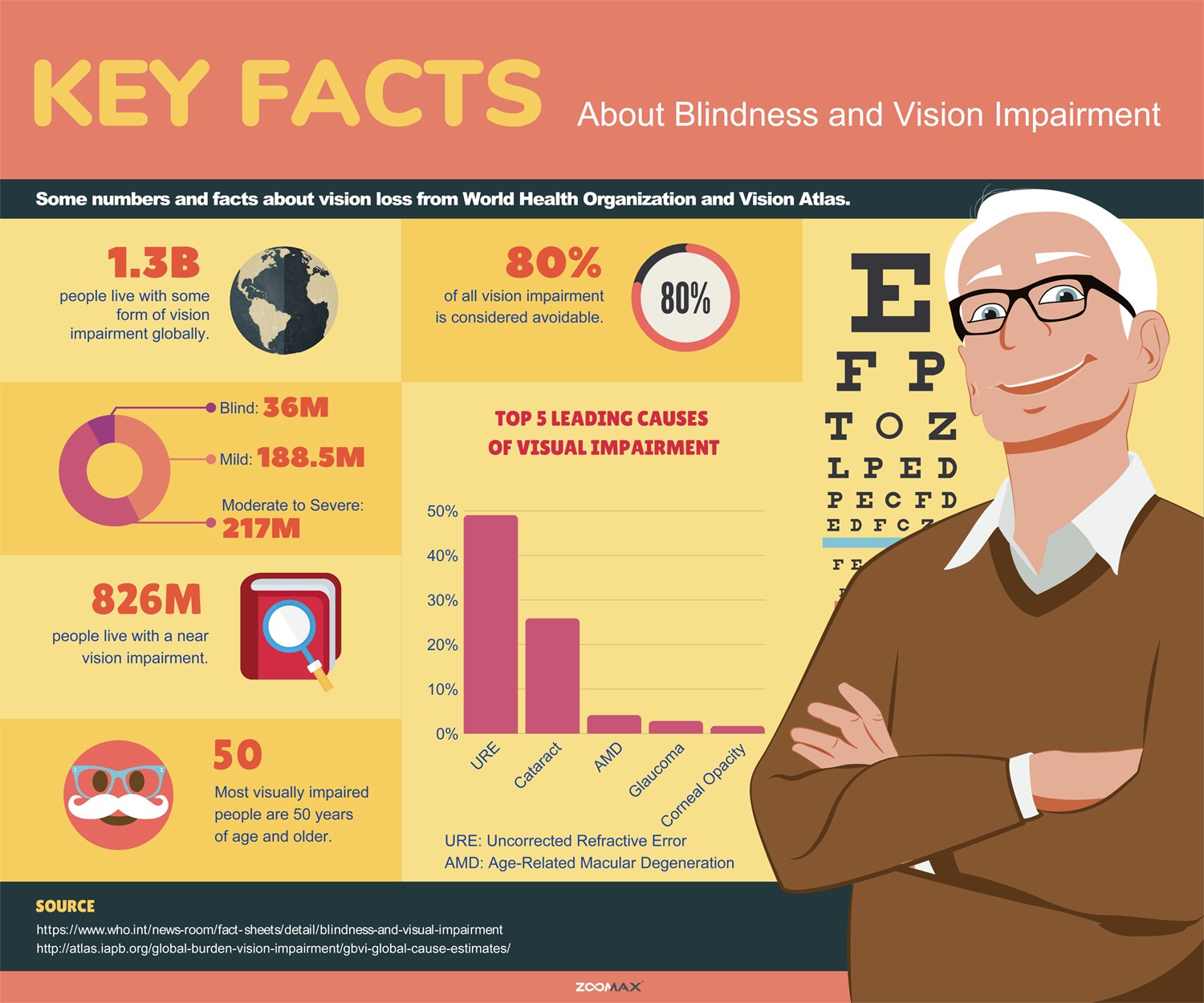
Information provided in infographic:
Key Facts About Blindness and Visual Impairment
Some numbers and facts about vision loss from World Health Organization and Vision Atlas.
Sources:
Blindness may be defined in a variety of ways. Typically, blindness refers to the inability to see. However, a loss of vision that cannot be corrected through glasses or contact lenses can also be considered a form of blindness. Researchers have found that blindness can be inherited as well as age-related. The Cleveland Clinic reports that more than 60% of cases of blindness in infants are caused by inherited eye diseases such as congenital cataracts, congenital glaucoma, retinal degeneration, optic atrophy and eye malformations. While genetic factors play a major role in blindness, the Centers for Disease Control and Prevention reports that the leading cause in the United States is age-related eye diseases such as age-related macular degeneration, cataracts, diabetic retinopathy, and glaucoma.
Statistics published by the National Federation of the Blind in 2016 indicate that 544,700 Florida residents of all ages live with a vision impairment. Additionally, there are 7,208,700 adults, aged 16 and older, with significant vision loss in the United States. It is imperative that we become more aware of these numbers and find new ways to support people with visual impairments in our communities.
Here are some helpful etiquette tips provided by the American Foundation for the Blind (www.afb.org) to utilize when communicating with blind people:
Blog by Golda Kelli Ryan of the Orlando Center for Independent Living (CIL)
Thanks for reading our blog. We'd love to hear about your experiences and thoughts on this topic, so please leave us a comment below! Also, feel free to comment other topics and disability issues you'd like to see covered on our blog. We strive to bring content that is interesting and valuable to you, and we can do that best with feedback directly from you.
Please do not leave requests for assistance in the comments. Blog comments are not monitored by intake staff and your request may not be seen. Visit our Online Intake Page to request our services.
Commenting is not available in this channel entry.Get clear, reliable updates on the issues that affect people with disabilities—without the noise or jargon. We’ll share practical information, important changes, and real stories that show how advocacy is making a difference. You’ll also learn simple ways to stay informed, get involved, and help drive meaningful change.
We care about your privacy and trust, and will never share or sell your email address.
Comments