Disability and Independence: Why Needing Support Does Not Mean Losing Independence
Friday, September 25, 2026
Friday, September 25, 2026
Most people rely on other people, services, systems, and technology every day. We use GPS to find our way, transportation to get where we need to go, doctors for health care, coworkers to get a job done, and family or friends for help when we need it.
We rarely treat those kinds of support as proof that someone is not independent.
But disability-related support is often viewed differently. A person may use personal assistance, accessible transportation, assistive technology, communication support, benefits counseling, or help with daily tasks and still be treated as though receiving support means having less independence.
For some people with disabilities, support needs may be more significant or more visible. That does not make those supports less valid or the person less capable of directing their own life.
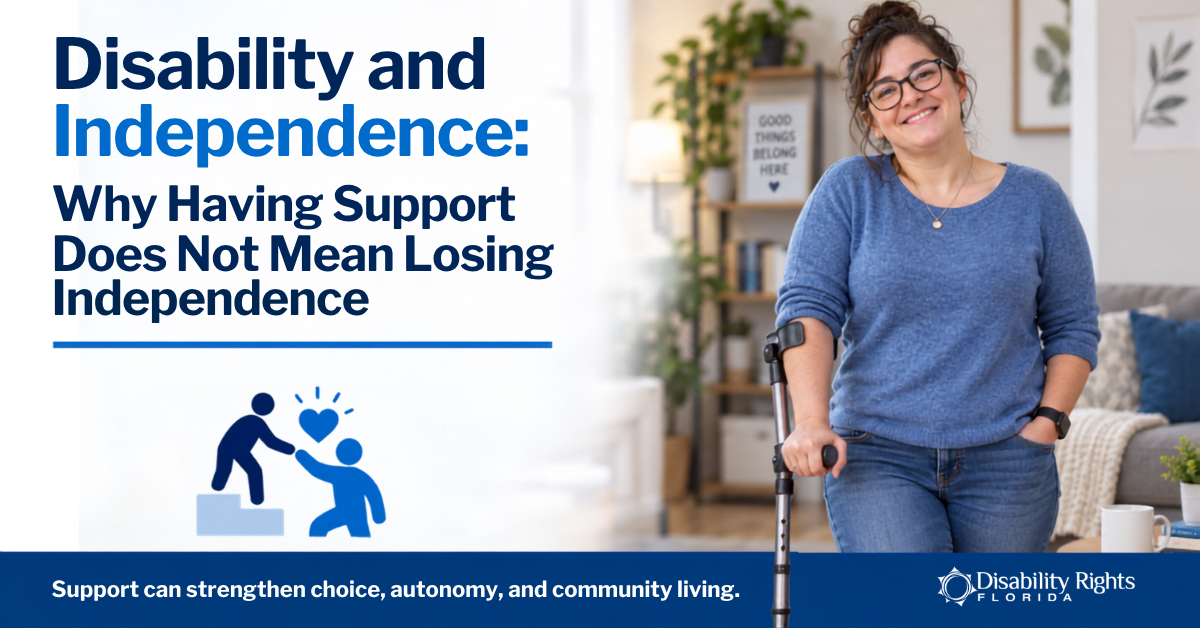
Independence does not have to mean doing everything alone. It can mean having meaningful choice and control over your own life, including deciding what support you want, when you want it, and how it should work for you.
Doing something independently can look different from person to person.
One person may complete a task without assistance. Another may use assistive technology. Someone else may have a personal care assistant, ask for help with one part of a task, or use a communication support to express a choice.
The presence of support does not automatically tell us how much control a person has over their own life.
For example, a person who uses personal assistance may decide when the assistant arrives, what help is needed, how that help should be provided, and what parts of the task they want to do themselves. That person is still making decisions about their routine and directing the support they receive.
The same idea can apply in many parts of daily life. A person may use accessible transportation and still choose where they are going. Someone may use a communication device and still be the one expressing the decision. A person may get help comparing options and still make the final choice.
Independence is not a test of how many things you can do without help. A more useful question is: How much choice and control do you have over the decisions that shape your life?
If independence is not simply about doing every task by yourself, it can be more helpful to think about who has a meaningful say in the decisions that shape your life.
That might include decisions about:
For some people, self-direction is one way to have more control over services and supports. Self-direction generally means that a person has a greater role in choosing, arranging, or directing certain supports rather than having every detail decided for them.
Florida has programs that reflect this idea. The Agency for Persons with Disabilities offers Consumer-Directed Care Plus, or CDC+ as an option for some eligible people receiving iBudget waiver services. Florida Medicaid’s Long-Term Care program also has a Participant Direction Option, or PDO for some eligible participants receiving certain services.
These programs have specific eligibility rules and requirements, so they are not options for everyone. But they illustrate an important point: receiving support and having control over that support can happen at the same time.
Independence can include deciding what help works for you, who provides it when options are available, and how that support fits into your daily life.
The right support can give a person more options for how they live, work, communicate, and participate in their community.
For example, transportation support may make it possible to get to work, attend school, shop, volunteer, visit friends, or take part in community activities. Personal assistance may help someone live in their own home, follow the routine they prefer, work, parent, or participate in activities outside the home.
Assistive technology can also open up choices. A communication device may help someone express their thoughts and decisions. Other technology may support reading, writing, computer use, mobility, environmental controls, school, work, or recreation. Florida’s Alliance for Assistive Services and Technology, or FAAST, helps people with disabilities explore assistive technology through information, demonstrations, short-term device loans, training, and other services.
Support can also make employment more possible. Florida Vocational Rehabilitation offers services that may include counseling, training, assistive technology, job placement, and other employment supports based on a person’s goals and circumstances.
For people who receive Social Security disability benefits, questions about work and benefits can sometimes make employment decisions more complicated. Benefits counseling, including services available through Social Security’s Ticket to Work program, can help people learn how earnings may affect their benefits and health coverage before making decisions about work.
In each of these examples, support does not take the decision away from the person. It can provide more information, remove barriers, or make additional choices possible.
Sometimes having the right support means having more ways to decide what comes next.
Support can look very different from one person to another.
A person may use or receive:
Some people may need support only in certain situations. Others may need support throughout the day.
There is no single amount or type of support that defines independence.
Needing more assistance does not make someone less adult, less capable of having preferences, or less entitled to make decisions about their own life. A person who needs significant daily support can still have strong opinions about where they live, how they spend their time, who supports them, what they want to do, and how that support should be provided.
It is also important not to treat using fewer services as a goal everyone should be expected to reach. The purpose of support is not to prove how little help a person can use. The purpose is to help the person participate in daily life in ways that reflect their needs, goals, and choices.
What matters most is not how visible the support is or how often someone uses it. What matters is whether the person has meaningful opportunities to express preferences, make choices, and have a say in the life they are living.
Making a decision does not always mean sorting through every detail by yourself.
A person may want help:
That kind of help can support decision-making without taking the decision away from the person.
This is sometimes called supported decision-making. It means a person gets help understanding, considering, or communicating choices while remaining involved in the decision itself.
For example, someone may ask a trusted person to explain information in simpler terms, help organize questions before an appointment, or talk through the pros and cons of different options. The supporter can provide information and assistance while still respecting the person's preferences and choices.
Disability Rights Florida has additional information about what supported decision-making is and frequently asked questions about supported decision-making in Florida.
Florida law also recognizes formal Supported Decision-Making Agreements. These agreements have specific legal requirements and are different from simply asking a friend, family member, or other trusted person for help thinking through a decision. The Disability Rights Florida FAQ provides more information about how formal Supported Decision-Making Agreements work in Florida.
The important distinction is this: receiving support with a decision does not automatically mean giving up control of the decision.
For many people, having the right information and support can make it easier to understand their options and make choices that reflect what matters to them.
Family members often play an important role in a person’s daily life. They may provide transportation, help with paperwork, attend appointments, research options, assist with meals or household tasks, support communication, or help remember questions.
That support can be valuable. The important question is who is making the decisions.
A family member or other trusted supporter can help someone understand information, think through choices, or communicate a preference without taking over the decision itself.
Supporters can ask themselves:
For some people, family support may be part of how they live and make decisions every day. For others, paid support, peers, friends, advocates, or other trusted people may play that role.
The goal is not to remove support. It is to make sure that support respects the person’s preferences, choices, and right to have a meaningful say in their own life.
Sometimes independence is supported by changing the environment, process, or way information is provided.
A person with a disability may use an accommodation such as:
Using an accommodation does not mean a person is doing less for themselves. It means a barrier is being addressed so the person can participate more fully.
For example, an employee who uses screen-reading software is still doing their job. A student who receives materials in an accessible format is still completing the coursework. A person who uses a communication accommodation is still the one expressing their needs, questions, and decisions.
An accommodation can be one more tool that helps a person participate, communicate, work, learn, and make choices about their own life.
Asking for an accommodation is not a measure of how independent someone is. It is a way of identifying what support or change would make participation possible or more effective.
Many people grow up hearing that adulthood means handling everything on your own. Asking for help can be treated as a weakness, while doing more without support is often treated as a sign of success.
For people with disabilities, those messages can create extra pressure.
Someone may hesitate to ask for an accommodation, use a mobility device, apply for a service, or accept help because they worry about what other people will think.
Thoughts may sound like:
Those feelings are understandable, but they are built around a narrow idea of independence.
Knowing what helps you participate, communicate, work, live at home, or manage daily life is useful information about yourself. Asking for support can be a practical way to solve a problem, remove a barrier, or create more choices.
The amount of help you use does not determine your worth, adulthood, or right to direct your own life.
Sometimes self-advocacy means recognizing that support could help and deciding that using it is the right choice for you.
Independence can mean different things at different times in your life. Taking a few minutes to think about what it means to you can help you identify where support is already helping and where you may want more choice or control.
Ask yourself:
1. What decisions are most important for me to make for myself?
Think about where you live, work, relationships, transportation, health care, daily routines, money, recreation, or other parts of your life.
2. What support helps me have more choices?
This could include people, services, technology, equipment, accommodations, transportation, or community resources.
3. Is there an area where I want more control?
Maybe you want more say over your schedule, who provides support, how assistance is provided, or how decisions are made.
4. Is there support I have avoided because I worried that needing help meant being less independent?
Consider whether an accommodation, service, device, or other support might make something easier or create more options.
5. What could become possible if I had the right support?
Think about one activity, goal, relationship, routine, or opportunity that matters to you.
There are no “right” answers. The purpose is to think about what independence means in your own life and what kinds of support help you keep meaningful choice and control.
Florida has many organizations and programs that can help people with disabilities learn about options, build independent living skills, explore assistive technology, prepare for employment, and find community resources.
Centers for Independent Living
Florida’s Centers for Independent Living, or CILs, are community-based organizations led by people with disabilities. Their services may include peer support, independent living skills training, advocacy, transition support, and information and referral.
Assistive Technology
The Florida Alliance for Assistive Services and Technology, or FAAST, helps Floridians learn about and access assistive technology. Services include device demonstrations, short-term loans, reutilized equipment, training, and information about technology that may support daily life, communication, work, education, or recreation.
Employment and Career Support
Florida Vocational Rehabilitation provides employment-related services for eligible people with disabilities. Depending on the person’s goals and needs, services may include counseling, training, assistive technology, job placement, and other employment supports.
Services for People Who Are Blind or Have Vision Disabilities
Florida’s Division of Blind Services provides services related to employment, independent living, training, and community participation for people who are blind or have vision disabilities.
Information for Older Adults and People Exploring Long-Term Care
Florida’s Aging and Disability Resource Centers, or ADRCs, provide information about long-term care resources, local programs, and state and federal benefits.
These organizations and programs serve different purposes, and eligibility requirements may vary. They can be useful places to learn about options, ask questions, and explore what kinds of support may help you have more choice and control in your life.
You can use assistance and still direct your life. You can ask questions and still make the decision. You can use technology and still complete the task. You can rely on transportation and still decide where you are going.
Independence does not have to mean doing everything without help. It can mean having meaningful choice, control, and a voice in the decisions that shape your life.
The support that works for one person may look very different from the support that works for someone else. What matters is whether the support helps you participate in daily life, make informed choices, and stay involved in decisions about your own goals, routines, relationships, work, and community.
The goal is not to need no one. The goal is to have the support you need while keeping as much choice and control over your life as possible.
Think about one area of your life where the right support could give you more choices.
Learn about your options, ask questions, and consider what kind of support would help you have more control over the things that matter to you.
Please do not leave requests for assistance in the comments. Blog comments are not monitored by intake staff and your request may not be seen. Visit our Online Intake Page to request our services.
Commenting is not available in this channel entry.Get clear, reliable updates on the issues that affect people with disabilities—without the noise or jargon. We’ll share practical information, important changes, and real stories that show how advocacy is making a difference. You’ll also learn simple ways to stay informed, get involved, and help drive meaningful change.
We care about your privacy and trust, and will never share or sell your email address.
Comments