Florida HB 991 Explained: What the New Law Means for Voters with Disabilities
Thursday, April 30, 2026
Thursday, April 30, 2026
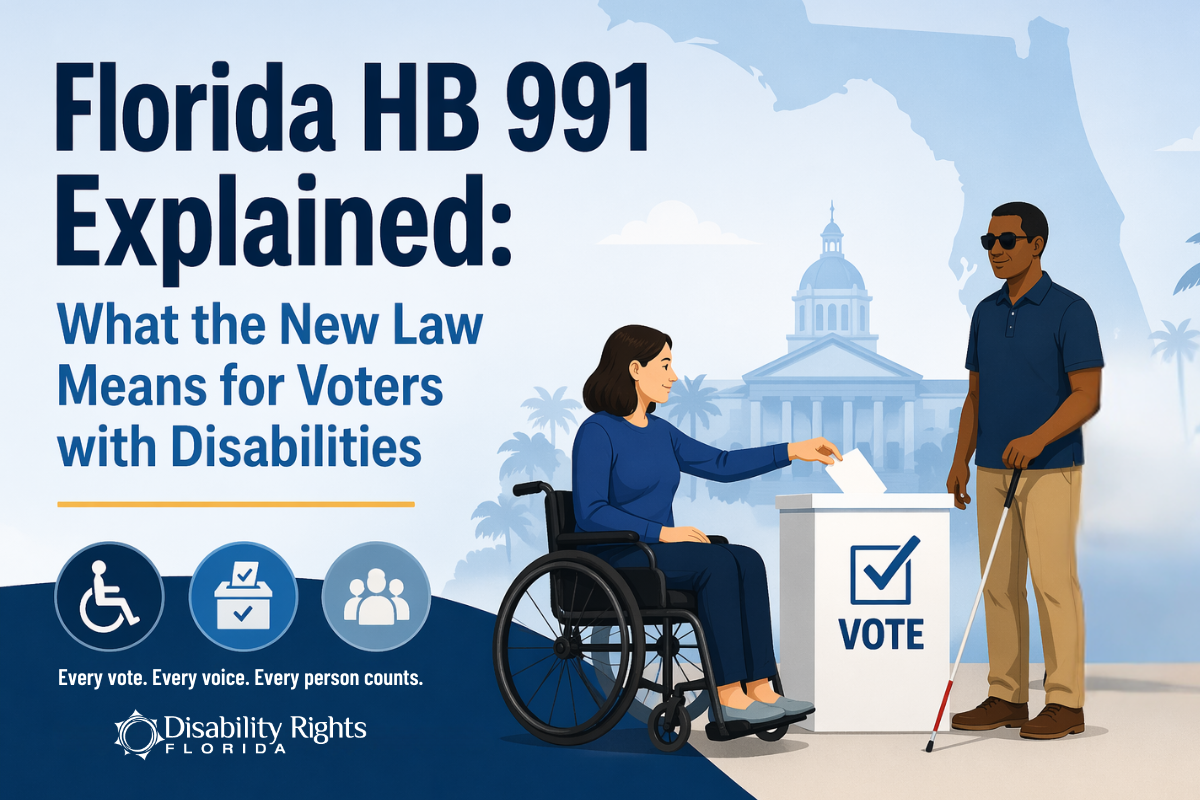
HB 991 adds new documentation and verification requirements to Florida’s voter registration system. For Floridians with disabilities, those changes may create new barriers to accessing the voting process.
When a law adds more document checks, more record matching, more mailed notices, and more follow-up steps, it adds more for people to navigate. For eligible voters with disabilities, those extra steps can matter. A process that looks simple on paper can become much harder when a person is trying to get records, respond to a notice, use a website that is not fully accessible, or work through paperwork that depends on exact matches across multiple government systems.
That is why HB 991 deserves attention.
Supporters describe the law as a way to strengthen election security. Disability rights advocates and voting access advocates have raised concerns about what happens when new administrative requirements are layered onto a system that already creates barriers for many voters.
So, what does HB 991 change, and why could those changes create added barriers for Floridians with disabilities?
HB 991 is a Florida elections law signed in April 2026. It covers several election-related topics, including candidate qualifications, election administration, and voting procedures. The part receiving the most attention changes how Florida may verify citizenship in voter registration and voter list maintenance.
Most of the citizenship-related provisions take effect on January 1, 2027. Another section requires Florida driver licenses and Florida identification cards issued to U.S. citizens to include citizenship status by July 1, 2027.
HB 991 also includes some features that resemble federal proof-of-citizenship proposals, including document checks and database-based verification. For Floridians with disabilities, the concern is whether those added requirements make the process harder to access.
For Floridians with disabilities, access to voting depends on more than legal eligibility. It depends on whether the process is clear, usable, and accessible from start to finish.
If the state adds more steps, the burden does not fall equally on everyone. Some people may be able to manage those steps more easily, including people who can:
For other people, the experience may be very different. Added steps may be harder to navigate for people who have:
Research on voting accessibility helps explain why this matters. National data supported by the U.S. Election Assistance Commission has shown that voters with disabilities report difficulty voting at higher rates than voters without disabilities. That same research has also found that voters with disabilities are more likely to rely on non-Internet sources of voting information, including printed mailings and television. In other words, changes in election law are not meaningful unless the information about those changes is actually accessible.
HB 991 makes several changes, but the biggest practical shift is that it adds new documentation and verification rules tied to citizenship in voter registration records.
Florida law now defines what counts as a “document acceptable as evidence of United States citizenship.” The list includes:
The law also adds an important detail that could affect many voters. If a person’s current legal name is different from the name on the citizenship document, that person may also need official legal name-change documentation.
That may sound small, but it is not. Marriage, divorce, adoption, and other life events can leave a person with documents under different names. For some people, collecting those records may take time, money, internet access, transportation, and help from others.
HB 991 also changes how online voter registration works in some cases. If the information a person enters matches state motor vehicle records and those records show acceptable evidence of citizenship, the registration may move forward through the online system. But if the information cannot be verified in that way, the person may be pushed out of the online path and into a paper process.
That matters because paper is not automatically accessible.
For some Floridians with disabilities, a paper-only follow-up process may create extra barriers, including:
The law also reaches beyond first-time voter registration. It can affect some applications involving changes in name, address, or party affiliation. In some situations, those updates may not be treated as complete until the required information is verified.
HB 991 also expands procedures for reviewing voter records when the state receives information suggesting that a registered voter may be ineligible based on citizenship status. In those cases, the law sets out notice, review, and possible removal procedures. The notice must include the basis for the potential ineligibility, a list of acceptable citizenship documents, and information about what may happen if the issue is not resolved.
This is an important point. HB 991 is not only about what happens when someone first registers to vote. It also changes what may happen later if the state decides a voter’s record needs more review.
Finally, the law requires the Department of Highway Safety and Motor Vehicles to share more citizenship-related information with the Department of State. By July 1, 2027, Florida driver licenses and state IDs issued to U.S. citizens must include citizenship status.
Paperwork can be an access issue.
That idea should be at the center of any conversation about HB 991 and disability rights. A person may be fully eligible to vote and still run into problems when a system depends on matching records, producing documents, reading mailed notices, and responding within a short time.
For example, a person may face barriers if they:
Voting by mail is part of this picture too. For many people with disabilities, voting by mail is not about convenience. It is about access. Some people cannot safely wait in long lines. Some may not have reliable, accessible transportation. Some may need more time at home to read and understand a ballot. Others may live in settings where traveling to vote in person is difficult.
HB 991 does not ban voting by mail. But when registration systems become more document-heavy and more dependent on record matching, the ripple effects can reach people who already depend on clear instructions, extra time, accessible information, or assistance.
The same is true for mailed notices. Under HB 991, if the state identifies a potential problem, the process depends heavily on notice and follow-up. That makes accessibility crucial. A notice that is hard to read, written in dense legal language, delayed, or misunderstood because of disability-related barriers is not just frustrating. It can affect whether an eligible voter understands what is happening in time to respond.
Fact: The law is broader than that. It is an elections bill that includes several different changes. But for many Floridians with disabilities, the most important issue is how the law adds more administrative steps that people may have to navigate.
Fact: No. The law can also affect some updates involving name, address, or party affiliation, and it expands review procedures for some existing voter records.
Fact: Eligibility and access are not the same thing. A person may be fully eligible to vote and still run into problems if records do not match, a notice is confusing, or a required document is difficult to obtain.
Fact: Not for everyone. Paper forms, printed notices, and mailing requirements can create added barriers for people with blindness and low vision, mobility disabilities, limited transportation, or a need for assistance.
Fact: No. The law lists several different types of documents that may count as acceptable evidence of citizenship.
Fact: No. Much of the law deals with registration records, document verification, state databases, notices, and follow-up before a person ever gets to the point of voting.
It is just as important to say what the law does not do.
HB 991 does not make a passport the only acceptable document. It does not take effect all at once. It does not apply only at polling places. And it does not eliminate the need for accessible election systems.
Federal disability rights laws still apply to voting. That includes voter registration, election websites, polling place access, and ballot access. Those protections do not disappear because a state adds new documentation and verification requirements.
At the same time, existing disability rights laws do not automatically solve every access problem. A system can still be difficult to navigate if notices are confusing, paper follow-up steps are not accessible, or public education is not clear and timely.
That is why implementation matters so much.
As the 2027 effective dates get closer, the most important questions will be practical.
Florida should be watched closely on issues such as:
These are not minor details. They are the difference between a process that is strict but workable and a process that becomes unnecessarily hard for eligible voters to navigate.
As implementation moves closer, some Floridians may also need time to address missing documents, outdated identification, or record mismatches that could become more important under the new law. Preparing now to get these documents may be a good idea if you are able.
For disability advocates, the core questions are simple.
Those questions should guide how this law is evaluated.
HB 991 is a major change to Florida election law, especially in the way the state may verify citizenship in voter registration and voter list maintenance. But for Floridians with disabilities, the most important issue is not the label attached to the law. It is the added bureaucracy that may come with it.
When a system depends more heavily on documents, matching records, mailed notices, and paper follow-up, the burden can fall hardest on people who already face barriers to information, transportation, technology, and administrative systems.
The real test of HB 991 will be how Florida puts it into practice. Eligible voters need a process that is clear, accurate, accessible, and fair.
That is what the public should be watching now.
Please do not leave requests for assistance in the comments. Blog comments are not monitored by intake staff and your request may not be seen. Visit our Online Intake Page to request our services.
Commenting is not available in this channel entry.Get clear, reliable updates on the issues that affect people with disabilities—without the noise or jargon. We’ll share practical information, important changes, and real stories that show how advocacy is making a difference. You’ll also learn simple ways to stay informed, get involved, and help drive meaningful change.
We care about your privacy and trust, and will never share or sell your email address.
Comments