The Tail of Two Animals: Service Animals vs Emotional Support Animals
Wednesday, April 28, 2021
Wednesday, April 28, 2021
Today is International Guide Dog Day. It’s a celebration of the highly trained animals who take the lead every day to ensure their legally blind owners live safely and independently. It also recognizes those dedicated to training these working canines and matching them with the right individual.
Guide dogs are protected under the Americans with Disabilities Act (ADA), along with all service animals who perform other vital tasks. We thought this might be the perfect time to talk about the difference between a service animal and an emotional support animal, your legal rights when you own a service animal, and what to do when your rights are violated.
The ADA defines a service animal as “any dog that is individually trained to do work or perform tasks for the benefit of an individual with a disability, including a physical, sensory, psychiatric, intellectual, or other mental disability. Other species of animals, whether wild or domestic, trained or untrained, are not service animals for the purposes of this definition." C.F.R § 35.104 and § 36.104 (2010).
An animal that doesn’t meet these guidelines is not considered a service animal. The ADA makes a distinction between psychiatric service animals and emotional support animals. According to the Department of Justice Civil Rights Division, Disability Rights Section, “If the dog has been trained to sense that an anxiety attack is about to happen and take a specific action to help avoid the attack or lessen its impact, that would qualify as a service animal. However, if the dog's mere presence provides comfort, that would not be considered a service animal under the ADA.”
Here are some of the tasks service animals perform:
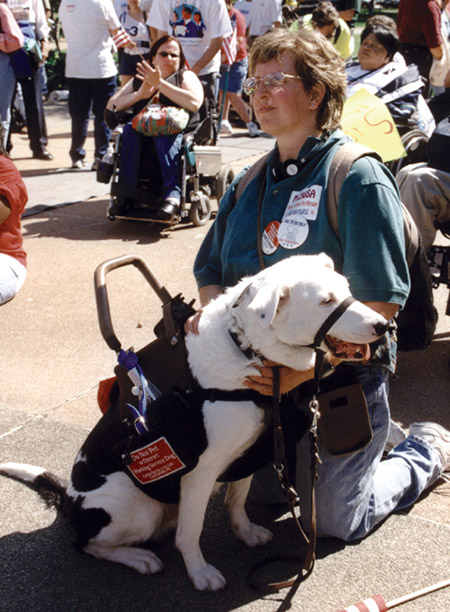
A service dog is not a pet. They are working animals dedicated to providing a service to their owner with a disability so that a person can experience a better quality of life and live independently. To that end, the ADA requires any place that is considered a “place of public accommodation” to allow your service animal to accompany you.
What is a place of public accommodation? Just about any place that is open to the public. It includes restaurants, movie theaters, schools (including colleges and universities), hospitals, doctor’s offices, retail and grocery stores, government buildings, parks, buses, airplanes, trains, taxis and rideshare services, etc. There are only two questions these entities can ask:
Here are some common requests you are not required to answer or comply with under the ADA:
The Fair Housing Act provides protections when renting or purchasing property in communities that have a “no pet” policy. Remember, service animals are not pets. However, you must make a reasonable accommodations request for your service animal when signing a lease or purchasing a home. Again, the leaseholder or homeowners’ association can only ask you two questions: (1) is your animal a service animal? And (2) what task has the animal been trained to perform? They also cannot require the dog to wear a vest identifying it as a service animal or demand a sign on a door identifying the occupant is a person with a disability who owns a service animal.
You have the right to travel with your service animal on public modes of transportation. This also includes private vehicles that are made available to the public such as rideshare services (Uber or Lyft). Because of recent changes to policies regarding emotional support animals, be aware that there is increased scrutiny and allow more time for the boarding process. Disability Rights Florida has additional information about your rights when traveling on our website.
Owners of service animals have certain responsibilities when they are in public places and in their homes. Dogs must be registered and vaccinated in compliance with local laws. When in a place of public accommodation, the owner must maintain control of the animal at all times. It cannot pose a threat to the health and safety of others, and it can’t disrupt neighbors or people around you with uncontrolled barking that is unrelated to the task it performs for you. And, as with all dog owners, individuals are responsible for locating appropriate or assigned waste areas for their service animal and you must pick up after them.
The most important asset you have in protecting your rights is a strong understanding of the ADA law and your rights as a person with a disability. Learn the law. And if you need help remembering your rights, carry the ADA's Fact Sheet on Service Animals with you.
If you are asked to leave a place of public accommodation because of your service animal, remain calm and ask for the manager. Try to control the conversation with your composure and calmly explain your rights under the ADA law. You’re not required to provide proof of the law, but you may consider giving the manager the ADA's Fact Sheet on Service Animals. If the manager insists you leave, you have several options:
Be sure to write down the names of every person you talk to as well as their contact information. You will need this if you want to pursue the violation later.
If you any have questions or need assistance advocating, contact Disability Rights Florida at 1-800-342-0823. Or visit the Service Animals Disability Topics Page on our website. Advocacy skills are important. So if you harness the right information, you’re likely to fetch better outcomes.
 Robin Kocher, Director of Communications & Outreach, oversees the agency’s branding, communications, marketing and outreach. She joined DRF in December 2019 and has a B.S. in Advertising from the University of Florida.
Please do not leave requests for assistance in the comments. Blog comments are not monitored by intake staff and your request may not be seen. Visit our Online Intake Page to request our services.
Commenting is not available in this channel entry.Get clear, reliable updates on the issues that affect people with disabilities—without the noise or jargon. We’ll share practical information, important changes, and real stories that show how advocacy is making a difference. You’ll also learn simple ways to stay informed, get involved, and help drive meaningful change.
We care about your privacy and trust, and will never share or sell your email address.
Comments
I am 70. When I was 8, I had a brain bleed and brain surgery for an AVM. I was able to get a guide dog from Southeastern Guide Dogs in Palmetto FL 10 years ago. Jim died a few months ago. I lost my family. The same school accepted me back this January. I was thrilled. Two weeks in and they told me to leave because I dropped the leash when getting off a bus. That was all they said. I had a seizure after they told me. Then I packed and my neice drove up to get me. Now I can’t get a dog. I believe it was really because I have some cognitive issues and have since 1959. Mental illness. This is not right. Is there anything I can do?
By Irene Carnahan on May 26, 2021
Hi Irene, the best thing to do would be to contact us at 800-342-0823 or online at disabilityrightsflorida.org/intake. An advocacy specialist will discuss your issues with you and determine if we can assist. And if we cannot, we’ll point you in the right direction.
By Disability Rights Florida on May 26, 2021