Disability Deep Dive Podcast
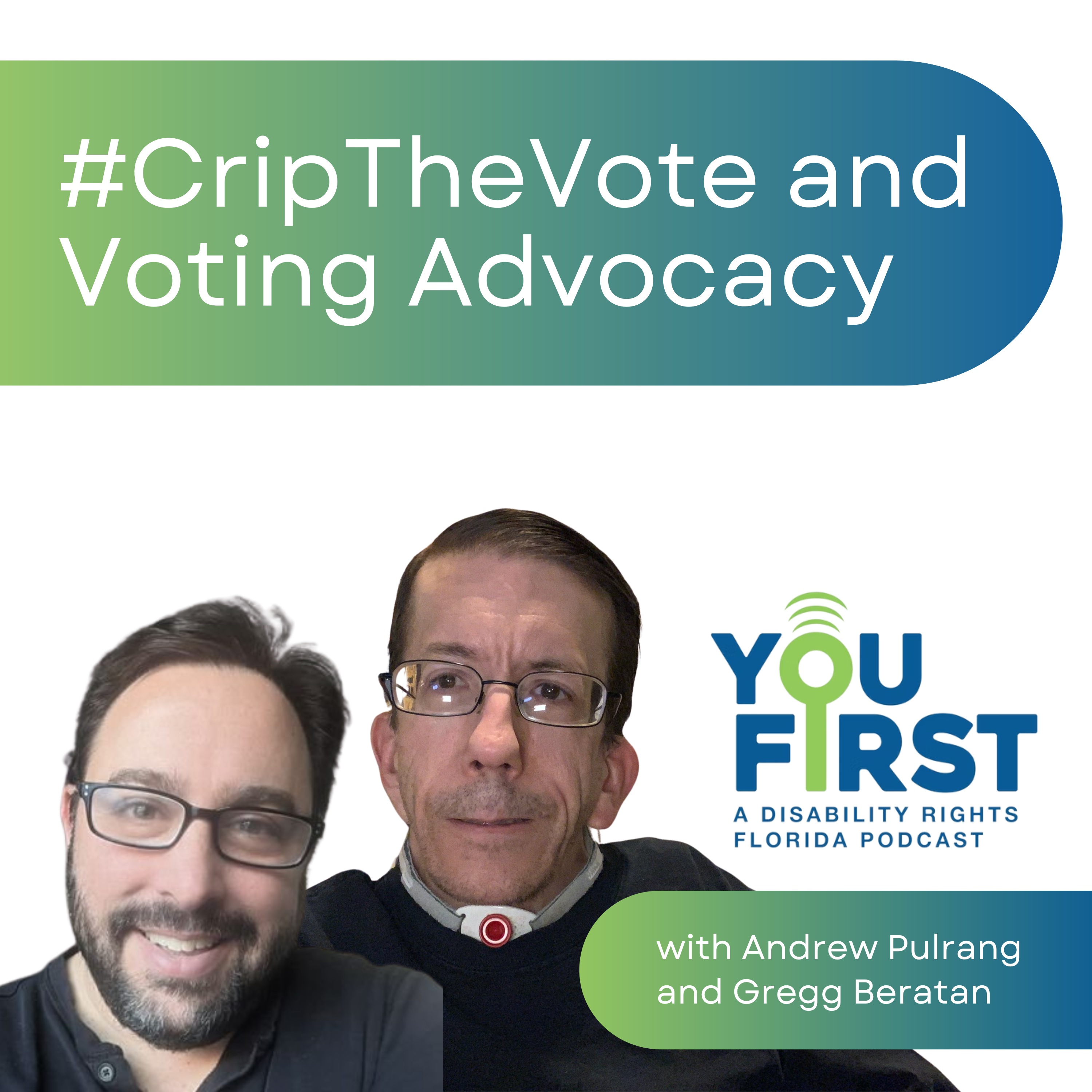
#CripTheVote and Voting Advocacy - with Andrew Pulrang and Gregg Beratan
Thursday, May 23, 2024
This podcast episode features Andrew Pulrang and Gregg Beratan, prominent figures in disability advocacy and social change. Their pioneering initiative, #CripTheVote, created alongside Alice Wong, has been important in raising awareness about the political power of disabled citizens and sparking meaningful conversations about disability, politics, and activism. Through their efforts, Pulrang and Beratan have used social media to foster a continuous online space that acts as a living archive for disability voting and civic engagement work. Our conversation also considers and discusses concerns and hesitancy around voting, especially for people with disabilities. We discuss the different approaches and why voting can be an effective way for people with disabilities to advocate for themselves.
Relevant Links
- Follow Andrew Pulrang on Twitter: x.com/AndrewPulrang
- Follow Gregg Beratan on Twitter: x.com/GreggBeratan
- Disability Rights Florida Voting Resources: https://bit.ly/3UN9bp6
- Access the Vote Florida: www.AccessTheVote.org
- Rev Up Campaign through AAPD: www.AAPD.com/about-rev-up
- Disability Victory: DisabilityVictory.org
- Detroit Disability Power: DetroitDisabilityPower.org
- New Disabled South: NewDisabledSouth.org
Episode Transcript
Maddie Crowley (00:00):
You're listening to You First: The Disability Rights Florida Podcast. In this episode, we talk with Andrew Pulrang and Gregg Beratan about the #CripTheVote and nonpartisan online movements encouraging the political participation of people with disabilities. Hey everyone, I'm Maddie.
Keith Casebonne (00:35):
And I'm Keith. And today we are talking with Andrew Pulrang and Gregg Beratan, who are prominent figures in the world of disability advocacy and social change. Their pioneering initiative #CripTheVote created along with Alice Wong has been important to raising awareness about the political power of disabled citizens and sparking important conversations about disability, politics and activism.
Maddie Crowley (00:59):
Through their efforts Pulrang and Beratan have not only used social media to great effect, but have also fostered a continuous online space that acts almost as a living archive and ongoing project for all things disability voting and civic engagement work. We hope you enjoy the episode.
Keith Casebonne (01:16):
Hey, Gregg and Andrew, thank you both so much for being our guest today. I'm Keith, I'm one of the hosts of the podcast. I'm a white male with brown hair wearing a black shirt. I have a salt and pepper beard and in my office with a beige wall and one piece of art behind me. If you could each introduce yourselves and give a visual description, we would love to hear it.
Gregg Beratan (01:40):
Sure. I'm Gregg Beratan, I'm that old male, white. Also gray my beard sitting before a white wall with a three-year-old's drawing behind me. I couldn't tell you what it is. Wearing black clothing and glasses.
Andrew Pulrang (02:00):
And I'm Andrew Pulrang, I'm a white man wearing glasses. I have short brown hair and the beginnings of a beard, mustache and wearing a green shirt. And my background here is basically my apartment, nothing special. That's about it.
Keith Casebonne (02:16):
Well, we're honored to have you both here today and can't wait to talk about the Crip the Vote hashtag.
Gregg Beratan (02:22):
Thanks for having us.
Maddie Crowley (02:23):
Yeah.
Andrew Pulrang (02:23):
Looking forward to it.
Maddie Crowley (02:24):
Awesome. This is Maddie, I'm a white person with blonde and brown hair, with clear glasses wearing a black sweater in front of a wall of many plants and artwork. And I'm the other co-host of the podcast. Yeah, I'm super excited to be chatting with you both today.
(02:43):
Could you tell us a little bit more about yourselves, whether that's what you're doing for work, how you have been involved in disability activism, anything related to your identities or things that you bring to this conversation that would be for our listeners to know if they've never heard of you or met you before.
Andrew Pulrang (03:04):
Sure. Yeah. I grew up through the '80s and '90s... really '70s and '80s and I guess I was an adult in the '90s, but I've had disabilities all my life and I formed my ideas around disability during the '90s and 2000s in everything that happened then with the ADA and all sorts of things.
(03:24):
And I worked for over 20 years in the Independent Living model and at an Independent Living Center where I live here at Upstate New York. And when I left that I went... partly because I wanted to explore disability issues in other ways than being the administrator of a nonprofit, which was interesting. Good in some ways, not in others. And really got into online activism and blogging, freelance writing, all this on disability matters.
(03:59):
And as part of that, a big part of that was becoming connected with Alice Wong and Gregg Beratan and others. And this campaign we call Crip the Vote. Yeah. So I mean, it's all part of a life-long interest in disability issues for personal reasons, but also because I'm a junkie for politics and the two go together in that way.
Gregg Beratan (04:28):
I don't know where to start. Like Andrew, I've been disabled all my life, although I probably spent the first 30 years of my life running from that identity trying to pretend it wasn't real or that it wasn't me.
(04:43):
And finding the disability community in my 30s made all the difference in my life, accepting myself as a disabled person and encountering other disabled people and understandings. The pride of being a part of that community really reshaped my life and the... I'm giving away my age, for the last 24 years since then, has been incredible because of it.
(05:11):
I work in disability rights in a variety of capacities. I've been in independent living for a number of years and now I'm currently working to ensure home and community-based services for people here in New York. But I've participated over the years and that's added so much to my life. I can't imagine who I would be or how my life would be without it.
Maddie Crowley (05:44):
Wonderful. Well, thank you so much for providing those introductions. You both do cross-disability work, not just in access and politics and the work of Crip the Vote, but this episode's going to focus on your work within Crip the Vote.
(06:04):
So for those who have never heard of the campaign and are a little unfamiliar about some of the issues with disability and voting, could you talk a little bit about how the campaign got started and what that whole process was like?
Gregg Beratan (06:21):
Yeah, for some reason I tend to do this part, but we were all... A bunch of us were online on Twitter and as part of the disability community in the mid-2010s, around the start of the 2016 election. And we'd seen, I don't know how many, 12 or so of these single-party debates in the primaries where they're talking around issues that are vital importance to the disability community. And no one's acknowledging that they are important to the disability community. No one's acknowledging the disability community, no one's even saying the word disabled.
(07:06):
And I think I saw tweets from Alice, Andrew and myself that probably happened at about the exact same moment where we were all saying, "What does our community need to do to get some love?" To put it mildly. And I reached out to the two of them and said, "I think we need to start a campaign." And I believe, Andrew, you can correct me if I'm wrong, Alice came up with the hashtag and we just took off from there.
(07:43):
At first, we didn't quite know what we were going to be doing. We thought we'd live-tweet some debates, maybe try and draw some attention to some issues, but then the community really took ownership of it and it just exploded. People were on the hashtag 24 hours a day. Did I miss anything, Andrew?
Andrew Pulrang (08:03):
No, I don't think so. And I think it's especially important to hit that last point that it did become a daily routine thing that people did just because they were paying attention and following the news and sharing links and sharing stories and experiences.
(08:20):
The only things that we organized were the live-tweeting debates and other election events like actual election days or return evenings. And these chats where we would set out an hour on, usually on a Sunday afternoon to discuss a disability topic that in some way connected with politics in policy and voting and stuff.
(08:46):
So we did those two, but those are the only really scheduled things. Everything else was just people using the hashtag to corral the conversation under one umbrella, so there was, if nothing else, so that it was easy to find and easy to follow. And that's where hashtags work when they work well.
Gregg Beratan (09:09):
The wonderful thing about it was just seeing the variety of ways the community chose to use the hashtag, seeing people come in and challenging particular politicians on things they'd said or asking questions of politicians they didn't know enough about, talking with each other about their takes on particular issues and how it applied to the disability community.
(09:35):
Understanding that election issues weren't just federal or state, they were local issues, things that were important to people and understanding really the breadth of who the disability community is. I think one of the things that came out very early on is that we are everyone and that we can't ignore any issues because they affect us all. So that was one of the wonderful things.
Andrew Pulrang (10:10):
I think another thing is that the three of us started by accident were perfect to spearhead it in a number of ways. And one of the ways that I'm only beginning to really understand is that we have different takes on whole thing, different personalities, and I would say it covered quite a few bases. Obviously not every possible perspective, but I mean, I would say that I probably represent more of the traditional politics junkie side of things like voting and elections and a normie political person, if that makes any sense.
(10:55):
Gregg [inaudible 00:10:56] a little bit more radical than I am on some things, but also tuned into that side because his job has involved various points, a lot of practical politicking and policy, but also has an academic background that I don't have. And then Alice is very much more of a cultural disabled person and attacks things from this side of disability culture and community and literature and that type of thing.
(11:25):
We were all obviously interested in these elections and felt they were high stakes, but we came at them from different angles and were able to bring those different perspectives in. So we had people involved who probably would've been involved anyway because they were politics people already.
(11:44):
We had others who were more academic. And then we had others who rarely got involved in politics at all, who started to dip their toe in the water. I think because of people like Alice inviting them in and saying, "This is something you should be into too," to lots of first timers.
(12:05):
People who are coming in saying, "I felt things about politics and disability and never felt like there was the right avenue to talk about it and now I do." And that they really valued that, so...
Keith Casebonne (12:20):
It's incredible really. First, thanks for answering that and giving us all that detail on the background of things. I remember it well when the hashtag exploded. It was one of those things that, like you said, when hashtags work well and so many times hashtags don't take off or they just don't work well in general.
(12:38):
But you're right, this is the very good example of one that just hit its stride at the right time quickly with the right people and was really powerful. And like I say, it just felt like it just was everywhere in no time at all. And it was fascinating, because it was one of the first times that I feel like I saw that sort of unity in the disability community on social media.
(13:03):
And it was really refreshing and powerful and I think has led to so many other attempts at using the internet for that social gathering and building disability community and that sort of thing. So really impressive. And like you say, you did just enough to get it moving and then it really took off on its own.
(13:23):
So I think one of the main reasons for that is the hashtag itself, the wording chosen for the hashtag. So if you guys could talk a little bit about the concept of reclaiming and so why you all chose the word Crip in #CripTheVote?
Andrew Pulrang (13:46):
Gregg, do you want to take that, or should I?
Gregg Beratan (13:49):
Sure, I can. I don't mind. There's a lot... We didn't invent the reclaiming of Crip. It goes back to early '70s at least, if not before then. But I think for us, and I know Andrew has some thoughts on this, because his thoughts have evolved on this quite a bit.
(14:12):
For us, there was something about that, not just the attention grabbing nature of it, but the fact that in many ways this lays out the claim that this is ours. The disability community can label something that way. It probably wouldn't be acceptable from anyone else. I don't mind anyone else using the term Crip the Vote, I don't mind someone talking about Crip culture. But using that label in that way really claimed that space for the disability community.
(14:50):
And I think to an extent that was what people latched onto, this is a safe space. And you saw that almost instantly. So when the odd person came on with a joke about gangs in response to seeing the hashtag, the community quickly said, "No, we're not having that." More than anything using the term Crip did that. More than the credibility that I hope Andrew, Alice and I brought to it. The fact that we said that label, that hashtag said, "This belongs to the disability community," was what helped it loop forward.
Andrew Pulrang (15:40):
Yeah, I agree with that completely. And the other thing I would say is that I see it as having two layers. You can make the argument that I think is a valid argument, why it's the right... it's okay to use it and have that debate. And I think it's defensible. I think on another level it is just a practical thing that, because it's a little bit daring or was, it did get people's attention and that kick got the ball rolling.
(16:17):
And let's be honest, it was partly a gimmick, and I think that's okay as long as in the end it doesn't just spiral off into being a perpetual gimmick and has some substance to it. I think that's what was good about it. It may have started out in some people's minds as a gimmick and caused them to say, "Well, what is this?" And that's good. It's that we had stuff to do with it once people got... we got their attention. That is what made it work.
(16:50):
And I do think it's important what Gregg said that at one point it is important that there were moments when we had slight confusion over concepts of appropriation or what have you, which people were not sure if it was okay for them to use it. For instance, the biggest question could be if you're a non-disabled politician and you want to speak to that community, the way to do that is to use the hashtag because that's literally how they work.
(17:22):
But then is that bad for a non-disabled person to use it? And we had I think we're very clear all along. No, that's perfectly fine. It's not that it's ours only to use, it's, "We created it, we came up with it represents us, and as long as you use it on topic, you're good no matter who you are."
Gregg Beratan (17:46):
There were some interesting discussions at the beginning and Andrew was really good at this. There were a couple people that said, "Look, I've had this word used against me. I don't fully feel comfortable using it." And Andrew said, "That's absolutely fine." And talking through our reasons for using it.
(18:05):
And eventually these people, because they were still listening, they were still paying attention to the hashtag and listening to the conversation and the dialogue and saw that it was meant in a prideful way, saw that it was meant in a way that wasn't hurtful to anyone.
(18:23):
And I think one of the people that most challenged the name of the hashtag was most uncomfortable with it eventually ended up using it quite regularly. And that was a really nice thing to see. Because I think that was... As Andrew said, there may have been something gimmicky to it with the flash of using it to start, but the substance that people put onto the hashtag was what brought people around, what carried it through and why people still use it today.
Maddie Crowley (18:59):
And as you're talking through it, I'm like, "Could it have been named something different? Could it have been coined something?" And I just kept coming back to how you were mentioning that person's experience where they were like, "This was a term that was used against me." Well, non-disabled people and in most of the world think of disability as a bad thing. So a lot of people would maybe have that reaction to no matter what you ended up naming it.
(19:27):
So I think that specifically choosing more of a stronger word rather than disable the vote or something, a more cheeky word that would've brought more intention to the forefront than maybe a more common word or a more, I don't know, appropriate word for day-to-day usage.
(19:51):
It's really inviting people and pulling them into the conversation saying, "Hey, this is really the essence of what we're trying to get at here is really to be challenging all of these things that we're considering on a day-to-day about disability, our value in the world, our ability to access things." And it can really take somebody right in the right direction of what you're trying to bring people into.
(20:17):
So it really is such an interesting way, as someone who studied linguistics in school, it's just such a cool way of using language to really have a cool purpose. It's not just on Twitter and like you said, it's not just disabled folks using the hashtag. It's become something so incredibly... It's become a tool for people to get the information they need and to reach the people they're trying to reach.
Andrew Pulrang (20:47):
Right. So we haven't done much with Crip the Vote over almost a full year, and we have no immediate plans to do any events, even though this is a massive election year. So I don't know if at some point we want to start reflecting the fact that it's a little bit of a past thing. Okay?
Maddie Crowley (21:14):
Yeah. Yeah, for sure.
Andrew Pulrang (21:17):
I don't follow it every day anymore, I used to. We have a thing up on our Facebook page that goes into... or in our blog or whatever that says, "The rationale behind taking a step back." And there are positive stories about that, that's not just a negative or any way really a negative thing.
(21:37):
Part of what I think was great about it and is great about it is that we did not try to institutionalize it to make it a permanent institution that had funding and copyrights and board of directors and a permanent mission. And, "We have to keep this alive forever because it's our baby that we love."
(22:07):
I think, and speaking just for myself, I feel like it served a purpose. And I'm not saying it's gone because people are continuing to use the hashtag and to tie conversations together, but I do feel like it's not necessarily a bad thing if people have begun to move on to some other modes of advocacy and that's what's happening. And I think we're okay with that.
Maddie Crowley (22:39):
And I love that. And I think the way that you all made it so it could be utilized as you all did events earlier on with the creation of the hashtag, but how I was thinking about it is, it's taken a life of its own. And those who are trying to find information about disability and elections disability and what their politician might think about something disability and some sort of healthcare thing that's going on in the news.
(23:13):
They might find, "Oh, my thought leader that I follow in the disability community, wow, they think this about it." Because that's where they can go find information. And I think that's really wonderful that you all were able to build something out that had that success. But yeah, I think there is something really to respect and acknowledge and honor when something has run its course in a certain capacity where you all were putting on events end thinking about it in a different way where now it has evolved to be this resource community giving thing that exists today.
Gregg Beratan (24:02):
I think what you're trying to get at and what I think we would both wholly agree with is that space has continued on. So one of the great things to me about the forum we did with you guys last year was hearing some of the incredible political projects that are going on around the country.
(24:29):
So things like New Disabled South, I think there was one Disability Power, Detroit. There are just some incredible projects going on, organizing on both local, state and regional levels to make issues real. I think one of the highlights for us in our organizing of Crip the Vote was hearing a presidential candidate in the last election saying, "All issues are disability issues." Because that was the point of the community.
(25:06):
And seeing others take that forward, take that and show how their region, their city, their state are impacting disabled people. That's an amazing thing. And I think that space does continue and some people are using Crip the Vote, some people are building off of Crip the Vote.
Maddie Crowley (25:28):
Right.
Gregg Beratan (25:30):
That's what we're thrilled to see because I mean, while we're not actively organizing things under Crip the Vote right now, we're still active members of the disability community. We're still partisan to the disability community. And I think that was something... And that's something we need more of and that's something I hope continues in many forms as we go on, including into this current election.
Andrew Pulrang (26:04):
Doing a quick calculation. We're creeping up on 10 years, right? It's 2024, we started doing this in late 2015, so you know what I'm saying? That's like a generation in politics these days and the disability community for sure. So it's good to see.
(26:24):
And I'm not implying at all that these groups... us to get it started, but in some ways it planted a bunch of seeds and helped... it nourish a bunch of seeds that I think are as important to take interest in as Crip the Vote itself. But the hashtag continues to be useful. That's certainly true.
Keith Casebonne (26:43):
Yeah, for sure. And when it comes to the internet and hashtags and let's even say pop culture and things like that, things move quickly and they do, I don't want to say have expiration dates, because not really accurate, but trends go up and down. And even things like this that are beyond just pop culture silliness, but things that actually mean something and matter to people and have led to change and awareness and community, they still have that ebb and flow and movement like that.
(27:14):
And so, I think it's natural to see that development of the hashtag and see a change from what it was to something else. And then maybe that will help encourage and stimulate other people in the community to come up with their own campaigns and their own direction of doing things. And maybe it'll be just as big or bigger than Crip the Vote was. So I think that all matters and I think it all works together.
(27:41):
And so what if it's not used the same now as it was then? I think that's normal and you wouldn't want to see... Even if it was still successful, it would also feel like it was stagnating and not really moving and doing something different. So I think it all makes a lot of sense and I can see that being a positive thing and encouraging others to come up with their own directions.
Andrew Pulrang (28:02):
Absolutely.
Keith Casebonne (28:18):
So let's shift a little bit from the hashtag itself to talk just a little bit about disability voter engagement itself as part of or separate from the Crip the Vote campaign, and let's talk a little bit about why that's important to you both. Maybe share some experiences or thoughts you have about disability voter engagement, any barriers maybe you faced to good experiences with voting or bad experiences you've had, that sort of thing.
Andrew Pulrang (28:43):
I think I would come at it from a standpoint where I have not personally experienced barriers that made it especially difficult for me to vote. I drive so I can get to my polling place, wherever it happens to be. I walk, although I don't walk as well as I did even in 2015. So at this point I'm voting absentee ballot, which is fine with me.
(29:09):
But I think it's important for people who have disabilities, especially who have it in their minds that voting is actually pretty easy and therefore something that everybody should just do and just quit whining about. I've heard that from other disabled people, they just don't understand why it's such a big deal because it's just, "You could just get an absentee ballot and what's the problem?"
(29:36):
To realize that there are millions of disabled people who really do run into barriers from inaccessible polling places to now, even more and even under more threat curbing the various accommodations that we might otherwise have, like not being able to vote by absentee ballot as easily or have only one day when you can vote because of voter restrictions and this effort to try and make voting if anything, harder.
(30:08):
So I think right now the biggest question is... one of the biggest questions in disabled voter engagement is, are we going to recognize how under threat our access to the vote really is and are we going to take it seriously? And I mean all of us, not just the activists who've been fighting about accessibility for decades, but just the everyday disabled voters who haven't seen it as a personal barrier, but need to wake up and realize that it could be.
Gregg Beratan (30:41):
Yeah, I was thinking something different when we talked about voter engagement, and I'll come back to that, but in terms of what Andrew said there, we've got a real mixed bag right now. On the one hand, you've got incredibly vast efforts to suppress votes across the board, across the country. And we're seeing that in states ranging from the Deep South to Washington state. This is not a regional thing, this is a nationwide effort.
(31:16):
But on the other hand, voting in many ways has never been more accessible. There was a center for... I've got it somewhere, the Center for Election Innovation and Research published a thing recently which said, "There are only four states currently not offering early voting access." That's incredible. Now that may be one of the few benefits we saw come out of the pandemic, but that is fantastic.
(31:47):
There are four states that don't allow early voting or mail-in voting without an excuse that I am willing to stand up and cheer for. Now, I want to get at those four states, and I certainly want to fight the attempts to suppress other votes, but it is a mixed bag and we've got good and bad.
(32:15):
But the other side of voter engagement is people feeling they're engaged with, not just having access, but feeling politics or politicians are talking to them or understanding their lives, or... I'm trying to talk to my kids about why any of this is important. And they say, "Well, they don't listen to us." And I say, "Well, that's something we've got to do better at making them listen and they've got to do better at listening."
(32:49):
But going back to that discussion of the space, the disability community created talking using Crip the Vote, and now with other efforts, I think that is how engagement moves forward. That is how we start to see people feeling they're being heard. Unfortunately, too much of party politics is about political power. It's about organizing to gain collective power, and it's not about governing.
(33:27):
Which is why I think I've clung to the notion of being partisan to the disability community because quite frankly, I don't see either political party looking out for us. As much as I love to, I probably won't vote for one party in many ways. I can't trust the other party either. I don't know.
(33:55):
Alice, Andrew and I were having some discussions about some of this, prior to this conference call, and we were saying there are a lot of people that don't want to vote for any of the two main candidates in this election, and they're being bullied out of any space they say that in. Because I understand the strong opinions towards either of the two candidates and the fear of one or the other being elected.
(34:25):
When you say you have to vote for this one to avoid that one, well then you're taking away the meaning of voting to many people. If people can't express their take on who should be leading us, even if that take doesn't have a possibility of getting elected, I would say, then nothing's going to change. And you're always going to be stuck with just the two bad choices. I don't know, Andrew, you had some thoughts on this as well, I know.
Andrew Pulrang (34:58):
Right. And I think this is an area where I've had a hard time evolving. Because I come from a more politically partisan standpoint, but I have learned to understand at least disability issues, to really accept that on disability issues that there are no... you cannot count on anybody understanding automatically, right? Even the people that you're otherwise allied with politically, ideologically, you will still have to explain to people the most basic things. So that's something I've learned partly through Crip the Vote.
(35:38):
But I also think, yeah, this issue of, frankly in this election year, more people perhaps having a hard time getting engaged and excited about either presidential candidate, particularly, where my take is that I've already pretty much decided that I'm not going to have a problem voting for a particular one, even though I'm not thrilled about it.
(36:06):
But what has angered me more than the people who have a different opinion on that is the people who, as Gregg says, trying to vilify and try to lecture and try to say, "You don't understand." And boy, oh boy, I tell you what, what disabled people particularly do not need more of is people saying, "You don't understand. Let me explain to you basic civics." And the thing is, I am exactly the sort of person who would normally probably be doing that.
(36:44):
My first inclination is to say, "But you don't understand supermajorities in the Senate and blah, blah, blah, blah, blah, and filibusters and lesser of two evils and the two party system and third parties never worked and blah, blah, blah." And I might be right on all that or wrong, I don't know, but that's my inclination. And 10 years ago I probably would've been doing that, and I'm really coming around to the idea that whether it's right or it's wrong, it's bad politics.
(37:16):
Any candidate who wants to actually win an election and have disabled people vote for them, should not be doing that, even if that's the most intense desire in their brain, do not lecture disabled people on basic civics. Now, yes, in Crip the Vote, I think we occasionally ran into people who took a sort of anti-voting position where you do find out that there are basic things they don't understand, but that is so rare. That's nowhere near the majority.
(37:54):
Most people who take these positions about voting of being disaffected are not just ignorant, they are people who have a thoughtful position that needs to be respected. So I think if you want to engage people to vote and you think it's important they do, we have to treat them with respect. And then the other thing, which I hope then maybe could be another topic is, besides which, the presidents are not the only people on our ballots is a general election year, which means everything is on the ballot.
(38:26):
And that includes your governor, your county legislators, your mayors, your village select people, school boards in some states, judges, all kinds of initiatives and ballot measures and whatnot. And you're allowed to skip voting for one of the categories and vote for all the others. You can actually do that, it's not going to kick it out. I would advocate voting for all of them. That's just me, you don't have to. And because you're not excited about one race doesn't mean that all the others are meaningless.
(39:04):
So lots of disability issues are decided at the state level and even local level. I'll just finish this bit by saying I live in Upstate New York, so does Gregg, and I think we both got snow dumped on us here in April. And something like snow removal, for heaven sakes, the president doesn't decide that neither do members of Congress, it's your local mayor and your city council or town council that decides whether they care to plow the sidewalks when it snows so that people in wheelchairs and on crutches and who are blind can get around their own towns. There's a lot of stuff to vote for that getting ticked off about one aspect of it should not prevent you from participating.
Gregg Beratan (39:53):
If we start from the position that every issue is a disability issue, then you have to understand that every election is important to disabled people.
Andrew Pulrang (40:01):
Exactly.
Keith Casebonne (40:03):
Yeah, I agree. Those are good points. And if they say all politics is local, so it really is true. Those local elections probably mean more to your day-to-day life than the national elections do. I was thinking-
Maddie Crowley (40:15):
In some ways.
Keith Casebonne (40:16):
In some ways, in a lot of the day-to-day ways, I guess to say, but you're right. And so as you all were talking, I was thinking about a conversation I had with my daughter who turned 18, and this will be her first election. And we were talking about, she was having the same issues with the two people running for president and talking about maybe not wanting to vote for either of them.
(40:38):
And I'm old and jaded, and I immediately went into that, "Wait a minute, now let's talk." And I have to say that in the end, she totally, she made her point and schooled me and made me stop and rethink a lot of the way I was going about it myself. And so, I think it just means be open and there's a lot of options. There's a lot of ways to do it. And who's to say my way, your way, someone else's way is the right way. And like you said, it's an individual expression. Voting is, it's an individual thing, and everyone who has an opinion of how they want to vote is a valid opinion and they should vote what they feel.
(41:14):
And yeah, it's bad politics to vote for one, just because you don't like the other, it's not really... So there's a lot going on, and it just reminded me of that. And I wanted to just briefly share, that's not really disability specific, but just the idea of voting and the ways to look at it.
Andrew Pulrang (41:29):
But again, literally-
Gregg Beratan (41:30):
It's exciting to hear that.
Andrew Pulrang (41:32):
That is amazing. Yeah. But literally again, the other side-
Gregg Beratan (41:36):
It's exciting that she stood up to you. Sorry.
Andrew Pulrang (41:38):
It's okay. No, I'm also impressed with that too. But the other side of the entire thing again going back is the right to vote and not having that suppressed. So it's oddly matched flip argument. One side is, are you going to persuade me to vote? And the flip side is, are you trying to keep me from voting? And I feel like we always have to keep both of those questions, those two plates spinning at the same time.
(42:10):
Because I think there are a lot of people who aren't sure they would want to vote, but who would not want to be forced out of voting by either legal or practical barriers. And I think there's a relationship there somewhere. They are separate but also related. So that's another way to look at it too.
Gregg Beratan (42:36):
I completely agree, and I think that's the thing about engagement, isn't it? It's both... You've got to persuade people to do this, you've got to convince them that it's important to their lives, but you also need to honor their right to do it.
(42:56):
And part of that right may be someone deciding not to vote it. It's not something I choose, but I remember a couple election cycles ago, there were two judges on the ballot here in Rochester, and I had experience with both of them and think neither should be on the bench.
(43:21):
So I honestly left that [inaudible 00:43:27], but that was... and for me, that was the statement because I couldn't make a statement in voting for one or the other. I couldn't choose one that I thought would benefit the people of Rochester or Monroe County, but I could make a statement by saying, "Look, I voted, but I didn't vote for either of these two."
Andrew Pulrang (43:53):
And also I think you knew stuff about them very pretty directly, and maybe this is the only lectury pitch I would make is there's difference between not voting because you have very compelling specific reasons and not voting because you just don't like the vibe.
(44:14):
I think there is a certain sense of everybody knows that everybody's bummed out this year. I don't know, that's the popular vibe, but maybe not... probably not sure of everybody. And maybe it's good to stop once in a while in the progress toward election day to say, "Okay, do I actually feel that? Or do I feel somewhat different? And am I just succumbing to the popular vibe or do I have real reasons for this?"
(44:46):
Again, that gets into lecturing people on what their motivations are. And I do think that it's an unfortunate stereotype that it's all about vibes, right? That's the people who are super angry that people aren't motivated. Their stereotype is that it's just a bunch of bummed out young people, and I'm like, "Maybe that's true a little bit, but probably a lot less than you think."
Maddie Crowley (45:16):
Yeah, this is Maddie, okay, as a bummed out young person, but who plans to vote. Yeah, and I really appreciate you mentioning that because I think so much of what is also going on is how our algorithms and online communities are really amplifying and recirculating a lot of the same opinions and, or feelings.
(45:45):
And then it's, "Whatever your situation is, it's not to say that's not valid, it's valid. And there are very worthy things to be for, against et cetera." And I appreciate the reminder and calling in of saying, "Hey, do I really feel this way or am I being swept up in the conversation? Or can I take a step back and reevaluate what this right means to me, how it impacts me, how it impacts my community, how it impacts my disabled friends who have a harder time voting, friends living in places that make it harder to vote?" Whatever it may be.
(46:24):
So I think circling the conversation to a bit of giving people the tools to then make a good decision for themselves, and also to use the resources that we have created and circulated through like #CripTheVote, other great new disabled-led voting organizations we talked about in the top of the episode. Yeah, I just think that's really important because so often it is a lot of the... I appreciate that you all named how the conversation has been formulating within the past 10, 15 minutes of the pod, but I think just reminding folks that, "You have a right to vote, you have a choice, you have a choice to change your perspective. You have a choice to engage or not engage and participate in a way that's meaningful to you."
(47:21):
And I think at the end of the day, that's the overarching theme of Crip the Vote, the overarching theme of this conversation. So I was just curious if we can pivot the conversation just a tad, especially for maybe a young disabled voter who may be feeling disheartened by their lived experience and maybe things they've navigated in their life who may need some support to vote or get involved in a local election or... I don't know.
(47:56):
What information or advice would you give to, especially new voters to who this might be their first election, "Hey, maybe look up who's in your city council, who would you like to vote for on there?" Maybe could we just reframe the conversation a little bit out of the doom and gloom of what's unfortunately here, but also give people the resources and almost like a little discussion guide to have with themselves to think through some of these things.
Gregg Beratan (48:29):
I think I'd start with looking at your life. Most people vote based on their lives and, "What is going to positively impact me in this election? What do candidates offer that will have this positive effect on me?" And that's going to be different for everyone. For some, that means, "Who's controlling my local social services department?" For some that means, "Who's appointing the judges that are affecting my right to choose what to do with my body? Because bodily autonomy is the biggest thing for me."
(49:11):
I think if you focus on those things, you'll find things to vote around in these elections, and you'll also find things to be really upset about, I'm sure. There are politicians that are more concerned with party politics. There are politicians that aren't thinking about the disability community at all, but you will find politicians that are engaged in things that will affect your lives.
(49:38):
I mean, the fact that there are so many threats to the disability community today, whether it's people trying to take away home and community-based services or policing initiatives or snow removal. There are so many of these issues. You will find something and someone that is concerned with those, and will have an answer that either satisfies you or doesn't satisfy you. I don't know.
(50:08):
I don't mind people thinking about themselves first in these things. I want to think about the disability community as well, because the disability community is important to me, but I think if you're thinking about your life, chances are some of these issues are going to affect other people too.
(50:30):
The other thing, and I don't know if this is tangential in some ways, but there are groups trying to talk disabled people into voting. I really want to see more disabled people... Not voting, running for office. I really want to see more disabled people running for office. I know Sarah Blachovec and oh God, her partner in crime, I'm sorry-
Keith Casebonne (50:50):
Neil Carter?
Gregg Beratan (50:51):
Neil Carter, that's it, are doing the disability victory to try and encourage people to run for office. I would love to see that happen. The more disabled people we have in office, the more people... the difference in the way we have to explain things to them. And so, I was recently talking to an assembly person who had been a personal assistant in New York CDPA Program, so explaining that program to them became so much easier.
(51:25):
But explaining why something's a disability issue to a disabled person is so much easier than it is to any other politician. I mean, I remember when I was working with the ADAP, we'd go to Tammy Duckworth's office and it was like we were speaking in shorthand. I mean, it was so easy. Because this is someone who used a wheelchair, understood some of the issues around home care. It just made things much easier to get through. You didn't have to do the same level of groundwork.
(52:00):
So I want more disabled people in office, and I'd love to see that as well. But that's off your question. I do apologize for the tangent.
Andrew Pulrang (52:09):
I don't think it's off actually. But yeah, I would add if you're in the position of maybe voting for the first time and aren't, especially if you're not motivated right now, not feeling motivated. One thing I would suggest is specificity, which... What I mean by that is if you have bad feelings about any part of it, start a dialogue first with maybe with yourself about, "Can I specify what those things are? Can I specify what would I like to see different?" And then go from there to say, then who are the people that in theory should be in a position to make that happen?
(52:50):
And that applies to everything from what's happening in Gaza, all the way to pandemic policy and home care, not only whether you got home care, but whether anybody's getting in their state or anything like that, or the way benefits work. Social security, when you have a job, whether you can have Medicaid and Medicare and stuff like that. To whether the code enforcement people even will listen to you about the places in your neighborhood that aren't accessible, any of that.
(53:25):
If you have bad feelings about them, particularly, then I think a starting point is trying to be specific with yourself about what you would like to see different, and then maybe a slightly methodical approach to that. That way you can break out of that thing where it's just a mood and into the next step.
(53:46):
Again, there's nothing wrong with the mood, and it's not that anger is bad or disappointment or depression, but breaking out of that into what's next, acknowledging that feeling, and then anything that I could potentially do in terms of voting that makes a difference. That way you can put your efforts into what is most important to you, and you might even find yourself slightly more motivated than you were before.
Gregg Beratan (54:14):
I would also urge people to find the space to voice your positions. I think one of the things we've seen particularly recently is that people wishing their opposition to... For example, the way the war in Gaza is being fought has shifted the response. Are people still satisfied or dissatisfied on both sides? Probably. But the more you express yourself, and this is one of the things we saw with Crip the Vote, the more you express your take on these things, politicians do care about your opinion. They do care about your position, and if they think that it's going to shift your vote on a particular position, they will consider it.
(55:08):
We've seen this over and over again. Politicians don't get elected without votes, and if you're making it clear that your vote is contingent on the right to bodily autonomy, then that's what's going to be an issue for them. I think the great thing we saw with Crip the Vote was disabled people from across the country, from every background speaking up and saying, "This is what matters to me. This is my experience, and this is what's important here for me." And make that space for yourself. If you're going to do that, politicians will listen. They'll have to, or they'll be out of work.
Keith Casebonne (55:53):
Yeah, that's all really great advice, and I think that's voters, young and old of all types really could think about a lot of those things you said and evaluate how they're planning to vote, what's important to them. And I do wish more young people in general, especially young disabled voters, would be interested in running for office.
(56:17):
I would love to see that kind of boom happen in the near future. I think that would be beneficial. Yeah. This has really been a wonderful, intriguing conversation with both of you. Either of you have any final thoughts or information or resources you want to share, plug, things like that?
Andrew Pulrang (56:35):
I would just, again-
Keith Casebonne (56:35):
[inaudible 00:56:36]
Andrew Pulrang (56:39):
Even though we're not doing an awful lot at the moment in terms of organized events, not that it won't happen. I would not rule out anything happening in the summer or fall when it gets close. I don't know. But whether we do anything or not... Again, if you're on X or whatever you want to call it or elsewhere, do you want to be part of this discussion? Add the hashtag to what you said out there. It's not going to hurt.
(57:05):
And then the thing is to click on it in other people's things so you see what other people say on similar topics, and maybe that may still be a good way for people to dip their toe in the water. It's disability and sort of election politics.
Keith Casebonne (57:24):
For sure. I think it's a good way to close out. So thanks again, both of you, Andrew and Gregg, we really appreciate you being here. Honored to have you as guests, so thanks again.
Gregg Beratan (57:35):
Great to be here.
Andrew Pulrang (57:35):
Thanks.
Gregg Beratan (57:36):
Nice to meet you, Keith. Great to see you again, Madeline.
Andrew Pulrang (57:39):
Yep, absolutely.
Maddie Crowley (57:39):
Thank you. Thanks so much, you all.
Andrew Pulrang (57:41):
We appreciate it.
Keith Casebonne (57:41):
Take care.
Gregg Beratan (57:41):
Bye.
Maddie Crowley (57:41):
All right.
Andrew Pulrang (57:44):
Take care, Gregg. Bye-Bye.
Maddie Crowley (57:46):
Thanks so much to Andrew and Gregg for being our guest on the show today. We had such a great time talking with you.
Keith Casebonne (57:52):
Yeah, we did indeed. Check out the show notes to learn more about the other things we mentioned in the episode.
Maddie Crowley (57:58):
And please take a moment and hit subscribe wherever you're listening to the podcast, so you'll get notifications when new episodes drop. You can also rate and review and share podcasts with other folks, and that will make sure that-
Keith Casebonne (58:09):
Please, please, please.
Maddie Crowley (58:10):
... yeah, more people can find this podcast that has been, I feel like going pretty well. And we have a great rest of the year of episodes lined up.
Keith Casebonne (58:21):
Yes, indeed.
Maddie Crowley (58:21):
So we want to make sure folks are listening.
Keith Casebonne (58:24):
We do.
Maddie Crowley (58:24):
We're on all podcast platforms, and you can listen or read the transcript of each episode on our website at disabilityrightsflorida.org/podcast.
Keith Casebonne (58:34):
Once again, thanks for listening. Please email any feedback, questions, or ideas about the show to podcast@disabilityrightsflorida.org.
Announcer (58:42):
The You First podcast is produced by Disability Rights Florida, a not-for-Profit corporation working to protect and advance the rights of Floridians with disabilities through advocacy and education. If you or a family member has a disability and feel that your rights have been violated in any way, please contact Disability Rights Florida.
(59:07):
You can learn more about the services we provide, explore a vast array of resources on a variety of disability related topics, and complete an online intake on our website at disabilityrightsflorida.org. You can also call us at 1-800-342-0823. Thank you for listening to You First: The Disability Rights Florida Podcast.