
Disability Deep Dive Podcast
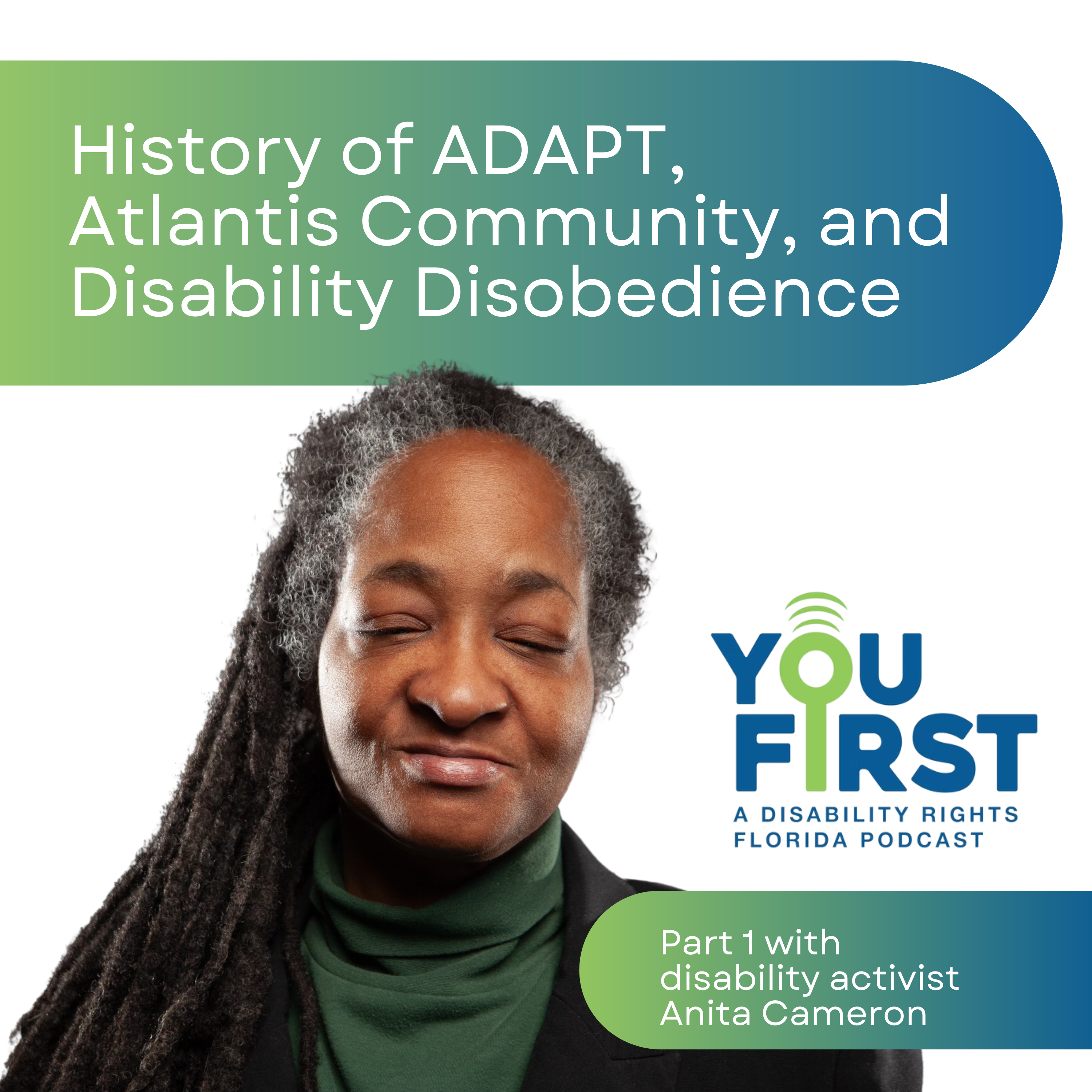
The History of ADAPT, Atlantis Community, and Disability Disobedience - Part 1 with Anita Cameron
Thursday, July 11, 2024
On this episode of You First, we talk with the fantastic disability rights activist Anita Cameron. Anita was, and still is, a core reason why we have disability rights today. They were an early adopter of disability rights and justice advocacy and heavily involved and a leader of the organization ADAPT (known throughout the years as American Disabled for Accessible Public Transit or American Disabled for Attendant Programs), the Atlantis community, amongst many other pivotal leadership roles. Anita joins us today to share the history of the disability rights movement and their own stories, experiences, and wisdom as someone involved in disability activism for decades. Anita will tell us about their work in this field, different protests, and the disabled disobedience that got us the crucial laws and protections we have today. We had the pleasure of speaking with Anita for over 2 hours and decided to split this into two episodes.
Lastly, we are up for a podcast award! Please vote for 'You First: The Disability Rights Florida Podcast' under the 'Society and Culture' category on the People's Choice website.
Relevant Links
- Anita Cameron website: https://bit.ly/3WfDA0Z
- Anita Cameron’s Twitter: https://x.com/adaptanita
- Dennis Schreiber: https://bit.ly/4cSBERv
- Disabled Americans Rally for Equality (DARE): https://bit.ly/3WeYaPb
- ADAPT – American Disabled for Accessible Public Transit or American Disabled for Attendant Programs Today: https://bit.ly/3Wghrj5
- Lighthouse for the Blind: https://bit.ly/4cCycLe
- Wade Blank – founder of ADAPT: https://bit.ly/3W0DIjx
- Atlantis Community: https://bit.ly/3WhHmac and https://bit.ly/3zytwat
- When You Remember Me movie: https://bit.ly/4czY4Hs
- We will ride! – The Gang of 19: https://bit.ly/4cz9b3D
- We Were There, Too: Blacks in the Disability Movement (coming soon – for info, follow Anita’s website or social media)
- Free Our People Micassa: https://bit.ly/3VWM4ca
- Gwen Jackson – ADAPT: https://bit.ly/4cx7mUP
- ADAPT history: https://bit.ly/3WhHmqI
- Healthcare Policy and Finance and Colorado ADAPT relationship: https://bit.ly/4czFfV2
- Find your local ADAPT group: https://bit.ly/3wT7NbW
Episode Transcript
Keith Casebonne (00:00:00):
You're listening to You First: The Disability Rights Florida Podcast. On this episode, we talk with legendary Disability Activist Anita Cameron about the history of ADAPT, Atlantis Community and disability disobedience. Hey everyone. I'm Keith.
Maddie Crowley (00:00:33):
And I'm Maddie. And we're the hosts of You First.
Keith Casebonne (00:00:37):
Today we have a fantastic interview with United States Disability Rights Activist, Anita Cameron. Anita was and is a core reason why we have the disability rights that we have today. They were an early adopter of disability rights and justice advocacy and was heavily involved and a leader of the organization ADAPT, which is known throughout the years, both as the American Disabled for Accessible Public Transit, or Americans Disabled for Attendant Programs Today. Also, the Atlantis community among many other pivotal roles.
Maddie Crowley (00:01:12):
Anita is here gracing us with their stories, experiences, and wisdom as someone who has been involved within disability activism for decades. Anita will tell us about their work in this field, different protests and the disabled disobedience that got us the crucial laws and protections we have today. We had the absolute pleasure of speaking with Anita for over two hours, and we decided to split that into two episodes. So you're listening to part one right now, and then in two weeks we'll have part two out, then they go together.
Keith Casebonne (00:01:43):
Yep.
Maddie Crowley (00:01:44):
But before we get to this interview, we wanted to let you know some really exciting news that we are up for a podcast award. You can vote for us throughout the month of July and help us win a People's Choice Podcast Awards. So how you can do that, you can visit podcastawards.com/up/signup, and we have that link on our website where this podcast is hosted and wherever you're listening, so you should be able to click that too. But for those that are listening, you'll go to that site, fill in some basic information about yourself to vote, then you'll navigate to the society and culture category and select You First: The Disability Rights Florida Podcast, under that category as your winner.
Keith Casebonne (00:02:36):
Please, please.
Maddie Crowley (00:02:36):
It should take you anywhere from 30 seconds to two minutes. So it's really not difficult and would help us out so much. So thank you so much for your continued support.
Keith Casebonne (00:02:45):
Thank you, thank you.
Maddie Crowley (00:02:46):
This year and over the years, and continuing as we move forward with the podcast, then we're really excited to potentially win an award. It'd be awesome. So please go vote for us. And without further ado, here's part one of our interview with Anita Cameron. Hey Anita, thanks so much for being on the podcast today. Could you please introduce yourself and provide a visual description for our audience?
Anita Cameron (00:03:11):
Sure. My name is Anita Cameron. I am a Disability Justice Activist, just turned 59, coming to you from the Unceded Land of the Haudenosaunee people, also known as Rochester, New York. I am a Black person with caramel-colored skin, very long gray locks, and a multicolored black dominant sweater. My pronouns are she, they.
Maddie Crowley (00:03:51):
Again, my name is Maddie. I'm a white person with blonde and brown, half-and-half hair with clear glasses, wearing a beige shirt and a silver necklace. Well, it's great to have you and we're so excited that you're here with us and for making this interview work, and we can't wait to learn more about you and educate our audience about the literal legendary disability activist we have today for our audience. Keith, you can go ahead and jump into these questions because I'm so excited to talk about this stuff.
Keith Casebonne (00:04:29):
Yeah. Oh my God, we have so much to ask and talk about for sure. As Maddie said, we're so thrilled to have you here. So again, my name is Keith, I am a co-host along with Maddie. I'm a white male with dark hair, salt-and-pepper beard, and wearing a gray shirt. Your journey Anita, as a disability justice activist spans over decades. Was there a particular moment that sparked your passion for advocating for people with disabilities? And how has your activism evolved over the years?
Anita Cameron (00:04:59):
Well, I got involved in disability activism actually by, I don't know, by accident is an apt description of what happened. I was 21, I had just turned 21, I was living in Chicago and was visiting my godmother, Sister Ann F. Mayer. And she belonged to a religious order, she was a nun, school sister in Notre Dame. And she lived at a place called Sister House on Chicago's West side. And I was visiting her. I had lived at Sister House for a little bit, Sister Ann, was one of my mentors, and she introduced me to the social justice and social change movement. And so I was involved in a number of movements and peace and justice, anti-nuclear, helping out people who are houseless, working with immigration lawyers, anti-apartheid, stuff with women's issues, Q activism, because I had just come out.
(00:06:23):
And I was at her house and she received a phone call from a friend of hers and she had speakerphone on so I could hear this conversation. The friend wanted to know if my godmother knew someone who could apply for a position to work with this gentleman who was disabled and said that this gentleman was a disabled activist who traveled around the country and he needed an attendant and interpreter and assistant to travel with him. And so they gave his number and all, and my godmother hung off the phone, looked at me and said, "Anita, your life is so full of adventure. Why don't you apply for this job? Call. I think you will be able to do great things."
(00:07:27):
And I placed the call to the gentleman whose name was Dennis Schreiber. Dennis worked at the Chicago Lighthouse for the Blind, but he ran a disability rights group called Disabled Americans for Equality, DARE. And DARE was a sister chapter to a group called American Disabled for Accessible Public Transportation, the group better known as ADAPT. And so when I called Dennis up, I spoke his wife, Jackie, interpreted, Dennis, became late deaf, and he had a rare genetic condition that caused, as he explained it, fat cells to grow on his brain that took away his organs off balance, sight and hearing. So he used the wheelchair, he was blind and deaf, but traveled around the country, worked at his job, and he had an interpreter that he used sign exact English. And so it was very important to be a very good speller.
(00:09:07):
And so Dennis and I, we hit it off. We found out we had a lot of friends in common in the social justice movement. And then he gave me a spelling test. It was an easy spelling test for me, but he seemed to be quite surprised that I passed it. I didn't know if that was because I was Black or what, I'm not sure. But he gave me another spelling test, which I passed. He gave me another spelling test, which I passed. He kept giving me spelling tests until he had convinced himself that this little Black girl knew how to spell. And so he then hired me on the spot for himself and invited me to come in and apply at The Chicago Lighthouse for the blind to work with him, which I did.
(00:09:59):
I got hired, became a Rehabilitation Service Aide at The Chicago Lighthouse for the blind. And my job primarily was to work with Dennis, traveled with him, be his interpreter, his assistant, his attendant. And then when I wasn't working with Dennis, I worked with other clients at The Chicago Lighthouse for the blind. I taught cane technique and occupational therapy and several other things. But I got really wrapped up in ADAPT. And a year after I joined ADAPT, I met in person, Wade Blank, the founder of ADAPT. He came to Chicago for our big year-end meeting. And he was a cat dude, I'm a cat lady. He loved to read, was a racist reader, so was I. He had that fire in his belly and so did I. A year after we met, I applied, I wanted to come out to Colorado and worked directly with Wade, his center, which was called Atlantis Community.
(00:11:16):
And so I went out and applied. Wade, invited me to come stay with him and Molly his wife and his kids and applied to work at Atlantis, which was an independent living center that he founded. There's a dispute about its place as far as when it was... Atlantis was founded in 1973, so that would make it one of, it is not the oldest independent living center. I believe that distinction and honor goes to Berkeley or the Ed Roberts Center, and then Boston, I believe, Boston Center for Independent Living, BCIL. And then I believe between BCIL and Atlantis, and I'll certainly give it to BCIL. But Atlantis had a wonderful history in the way that it was formed, how the Ed Roberts Center, basically, if you will, was formed with the queer folks. Remember he was in college and they had to house him in the special, and he went anyway. And I believe that led to the formation and led to the Independent Living movement.
(00:12:47):
Wade Blank, in 1973, he got 40 disabled young people out of a nursing home in Denver, Colorado. Check out this movie called When You Remember Me, the stars, Ellen Burstyn and Jeff Savage and Kevin Spacey plays the part of a gentleman called Wade Black. They changed the names in the movie. So Wade Blank's part was played by Kevin Spacey. And the movie was about a guy called Michael Patrick Smith, but in the movie, his name I believe was changed to Michael Patrick Mills. The nursing home that he was in was called Heritage House. But when they were preparing for... And you got to understand, I know this because I was president, I was there for all of this when they were making the movie, Heritage House at that time was still open, and they threatened to sue if the actual name was used. So I think they changed it to Hysteria House or something like that.
(00:14:04):
Wade was an Activities Director there. He wound up in Colorado after... So Wade marched with Dr. King on Bloody Sunday. A lot of people don't know that. But he had a college roommate in Ohio who accused him of being a racist because he was a Barry Goldwater supporter and dared him to come with him to March on Selma with Dr. King and Wade did. Then Wade was also involved in the Kent state protests, SDS, that horrible tragedy at Kent State. He was one of the SDS protesters. That, [inaudible 00:14:48], him. And he pulled back, he winds up in Chicago getting his divinity degree. And then wound up going out to Denver where he becomes an activities director in this nursing home.
(00:15:02):
And he began to do amazing things with these young people. And the nursing home administrators and all, they were threatened. They began to do stuff with Wade and the young folks, wound up firing Wade, there was abuse going on. They brought a lawsuit against the nursing home involved with a lawyer named John Holland. I've had the honor of meeting John, and they won a $2.8 million lawsuit. And those folks were able to get out of the nursing home.
Keith Casebonne (00:15:41):
Wow.
Anita Cameron (00:15:42):
And they formed Atlantis Community. Once they got out into the community, they learned the hard way that, "Hey, we can't do things and go places where everyone else can go, and particularly riding the buses and getting around." And they got out into the community and started attending the meetings of the regional transportation district, which is Denver's Transit Authority, asking them to put lifts on buses. And RTD kept saying, "No, no."
(00:16:18):
And so on July 5th and 6th of 1978, 19 young folks, I believe the youngest was 13, the oldest was 21 or thereabouts, gathered up at Colfax and Broadway. It is the busiest intersection in Denver, and it was the site of, and still is of the major bus barn. I know of what I speak because I moved to Denver and I lived not five blocks from where this took place, and I caught my buses every day at that intersection. On July 5th, 1978, 19 young folks gathered at that bus stop, tried to get on the bus and couldn't. So they got out of their wheelchairs and they laid in the street for two days fighting for the right to get on buses. We Will Ride was born. That was the shock heard around the world, if you will. Took place, I believe a little over a year after the 504 Sit-in. During this, they got support, major support, and the story spread about what happened. And disabled people from other cities, including Chicago, was saying, "Hey, teach us how to do that."
(00:18:03):
And ADAPT was born in 1983 in Denver and Chicago ADAPT was born in 1984 in Denver, and that was my original chapter. But like I said, I wound up applying for a job in Denver. I didn't get that job, but Atlantis Community had just opened a satellite office in Colorado, Springs and Wade said, "Anita, go to down to Colorado, Springs applied for that. Maybe you can get a job there." So I hopped on the Greyhound and went and applied for that job as co-director of their learning center, where they taught independent living skills to disabled clients. I applied for the job. I didn't know, I went back up to Denver, spent a couple of more days with Wade, learned that a dear friend of mine had passed away while I was in Colorado. That's another amazing story. But when I went back home on Thursday, come home on Monday, on Thursday, I receive a call saying that I got the job.
(00:19:15):
So I get my stuff packed, hop on the Greyhound, get out to Denver, stop in to see Wade, his family, didn't plan, I just showed up on the doorstep. But Wade being Wade he, "Hey, what's up? Wow. You got the job." We had dinner and everything. The date was significant. It was Wade's birthday, December 4th, 1987. It was Wade's birthday. I started my job at Atlantis Community on Wade's birthday. I got down there and did really good, too good. Learning Center became famous all over the TV and everything. And then I get called into the office, "Hey, do you want to organize for ADAPT?"
(00:20:11):
And I said, "Of course. That's what I moved out here for." So I began organizing and I was in Colorado, Springs until 1991 when I transferred up to Denver to work directly with Wade Blank. And those were amazing times until Wade passed away in 1993. I think I'll stop right there. I don't even know if I answered your question because when you all give me the mic, unfortunately, I just go on and on in my brain, I remember things and whatnot. I don't know, I may have undiagnosed ADHD because I jump and my mind can't... It just goes.
Maddie Crowley (00:20:56):
No, you're good. This is Maddie. No, that was a phenomenal backstory into how you found your way into disability justice activism, explaining the context of ADAPT and Atlantis and DARE and all of these key players that really formulated the beginning of your career and the collective beginning of disability justice and disability activism within the entire United States. And I think that was phenomenal. And I think that history can unfortunately be sometimes hard to find online, so I'm really happy that we're able to highlight that and we'll link to more resources and information about that.
Anita Cameron (00:21:42):
This could certainly be part of the, I don't know if y'all are aware of my project, We Were There Too, Blacks in the Disability Movement. And it's because the stories of the participation of Black disabled in our movement has either been erased or whitewashed. We really don't know that. And so what started as a rant in 2015 has now turned into a full-fledged funded project that I'll be doing. Eventually I'll be doing podcasts and stuff like this. And so another reason why I'm really happy to be here that we are capturing these stories because so many folks, they've died, they passed on, they joined the ancestors. And I want to catch those stories, chronicle those stories from those warriors who were in the street or their family members, survivors and all. And so thank you again for this opportunity.
Maddie Crowley (00:22:47):
Yeah. And just to clarify from your website, that was the project that you helped create with other folks? The We Were There Too Project, Blacks in the Disability Movement, right?
Anita Cameron (00:22:58):
Yes.
Maddie Crowley (00:22:59):
Okay, awesome. You have a very expansive and full resume of tons of important work. So I just want to make sure when we're discussing this that we can name and link to those things so we can point them to the right direction.
Anita Cameron (00:23:15):
Well, I'm setting up a web page for the project. I'm working on that now with the web developer. You probably found out on my other Anita Cameron site. But I was one of 10 Black disability justice activists to receive funding for my project this year. Got funding in April, and it's a grant of $50,000 for two years and looking at more funding, because obviously I want this project to go beyond two years. And so I'm in talks with various other funders, MacAuthor Foundation, Ford Foundation, [inaudible 00:23:58]. Again, they were ones who funded me. So looking at that, because it's so important, and I think that those unsung heroes and warriors need to have their flowers. Unfortunately, a lot of them didn't get their flowers before they passed away. And the folks that I know, or folks whose names you've never heard of, but who were out there doing the important work.
Maddie Crowley (00:24:32):
Definitely. And as that website comes out, please feel free to send it to us. We'll promote it on social media and through our podcast networks as best we can, so that we continue to tell the full history of this movement. As you talked about some of these different organizations, you talked about ADAPT, which has been a huge, significant part of your activism journey. Anita, could you share some of your most memorable moments from your involvement with ADAPT and how civil disobedience has been instrumental in advancing the rights of the disability community?
Anita Cameron (00:25:25):
Well, civil disobedience has been a critical part of how we in the disability community have gotten our rights. Because civil rights aren't given, I say it all the time, civil rights aren't given, you got to fight to get them, and you got to fight to keep them. ADAPT, most memorable moments, there's so many. There's so many, it's almost a blur. So many memorable moments. Coldest action I participated in, it's a toss up between Lansing, Michigan and Washington, DC. I'm going to say Washington, DC. DCCDLT, ADAPT was signed to get a meeting with Secretary, Sam Skinner. He was Secretary of Transportation at that point. This was March of 1988. And it was negative four degrees. We took over it, Department of Transportation building. I was the last person to get in safely. At that time, I was walking, I was not using my wheelchair.
(00:26:43):
I got in and we held the building for over 30 hours. We were left in the building with no access to restaurants, no access to water or anything. We were in the dark. Justin Dart and Mitch Snyder, I believe his name was Mitch Snyder, was an activist who worked with houseless people in Washington, DC, were well known for that. I think he passed away. Came with hot soup for us. Justin Dart was down there, got food for us. Except that those of us inside, we didn't get food. Those of us outside in the negative four degrees, thankfully got the blankets, warm blankets and the hot soup and everything. And the folks on the outside were trying to get food to us on the inside, and they were smashing together slices of American cheese and trying to slip it through the cracks on the door because all we had was, [inaudible 00:28:03], water that some of the reporters had left before they... So we didn't really have anything. And some of us had snacks on us.
(00:28:12):
And I was very young at that time. I think I was, I'm going to say 22, maybe 23, and I was going around feeding folks and emptying urinals and stuff like that, and fell in love. That was what I wanted. When I was a little kid, I learned very early about the Civil Rights Movement. Dr. King was assassinated less than three years after I was born. And I was born into history, I was born less than a year after the enactment of the 1964 Civil Rights Act. When I was born, Black people did not yet have the right to vote because the 1965 Civil Voting Rights Act would not be enacted until August of 1965 when I was two months old. Stonewall happened while I was busy turning four years old, Stonewall happened.
(00:29:46):
I learned about all this stuff as a child and felt guilty, especially being too young to participate in the Civil Rights Movement, the freedom and liberation for Black folks here in this country. I was born too late and I felt guilty for that. So when I was nine years old, I made this vow that I would work to make the world a better place. I didn't know how I was going to do it, what I was going to do, I wanted to do that. Because I learned that in the Civil Rights Movement, the protesting and all of that, anybody could participate, children as young as six went to jail. I was born too late. But I vowed that I would work to make this world a better place. Like I said, didn't know how, what I would do. At 16, I got that opportunity when I joined Peace and Justice Movement, started doing social justice.
(00:30:55):
I was born in Chicago on the south side on my block. The ladies from the Black Panthers used to feed the kids, The Black Panthers Children's Breakfast Program. And then we wound up moving. My dad got into real estate, so we wound up moving even further south. And I went to a grammar school, [inaudible 00:31:32], a Black poor of the Harlem Renaissance, Countee Cullen. So I always knew, I always felt, and based on what I read, civil disobedience, that was the only way you got civil rights. Even the women's suffrage movement, civil disobedience. Back in the day, they used to compare, ADAPT to the Black Panthers and Act Up. They were trying to be mean. They referred to us as militants and radicals. To be compared to the Black Panthers and Act Up to me was a badge of honor.
(00:32:17):
We had ADAPT members who were Black Panthers. And I did protests with Act Up back in the day. I was probably the first openly ADAPTer. Used to wear these pink triangle buttons on my cap, clothes and everything like that because back then it was still quite dangerous to be out. And I had already gotten gay bashed. Me and my homie coming out of a lesbian bar, we got jumped by five dudes. Police didn't even want to take a report. And even in this day and age, sometimes I am still afraid to hold my wife's hand in public because I know what it's like to be gay bashed and I know that they're trying to criminalize us again. My wife and I had to go to Canada to get married.
(00:33:24):
And so I saw even in ADAPT, you look, okay, so we're coming up on the 34th anniversary of the signing of the Americans with Disabilities Act, and there was civil disobedience to make that happen. We think the Capitol Crawl was, we think the Rotunda takeover was. I was part of both actions, Capitol Crawl and the Rotunda takeover. Rotunda takeover, 104 people were arrested. I was number 81. That was amazing times. And people talk about the Capitol Crawl, and it was amazing and historic in and of itself. But I believe personally that the Rotunda takeover was what got the ADA passed and signed into law. We had Congressman Steny Hoyer there. We had House Speaker, Tom Foley there trying to placate us and whatnot as we're screaming and chanting, "Access is a civil right. ADA now. We will ride."
(00:35:05):
We didn't believe them running their mouths. They left. Once they left, the noise was so loud, the chanting was so loud, it reverberated throughout the entire Capitol complex, I kid you not. I'm not lying, I'm not exaggerating, it was that loud. And those of us who were arrested, we had different outcomes. Some of us had really high fines, some of us went before a judge who cried, literally cried and dismissed their charges. Of course, I would be one of the ones who went to jail. I was overnight in jail in DC, but the ADA was signed into law and I'm honored that I had a part in getting that pass and being out there in the trenches, blocking buses, chaining myself to buses, blocking buildings and whatnot.
(00:36:23):
They had in 2017, the fight for Medicaid and all. Everybody credits ADAPT for that without even really knowing who ADAPT is. That was the summer of ADAPT. I was dragged out of so many offices, it wasn't funny. I got dragged out of Mitch McConnell's office in Washington, DC, arrested as well. I organized a week-long vigil in front of the Republican headquarters in Rochester, trying to get them to come up out that Better Care Reconciliation Act. And then we went to his house, [inaudible 00:37:15], his neighborhood. I was then dragged out of several others. This was my 131st arrest. We went to Ohio to try to get a meeting with Senator, Rob Portman. Didn't turned out too good. I was dragged out of his office, arrested. We went to jail and we spent overnight in jail.
(00:37:44):
Had to defend my wife against other prisoners. My wife was sleeping hard, she was snoring. Inmates didn't like that. Came over, literally came over, lady in a wheelchair, willed herself over, going to do harm to my wife. Needless to say, that did not happen. And the young lady wheeled herself back over to her bed. And that's not the first time I'm going to jail for ADAPT, I've been arrested 140 times. I spent 20 days in jail for ADAPT, 20 days, 10 days, three days, several times, two days, bunch of overnights, few hours. Been arrested more times than any disability activists in the United States. Didn't set out to do it, it's just I believe in what I do and I have that passion and I'm more than willing to be arrested and go to jail for what I believe in, [inaudible 00:39:14], justice. That's a couple.
(00:39:16):
In 1992, we were in San Francisco, I got arrested. They took us to jail. You know that Otis Redding song? << Sittin' on the dock of the bay, watchin' the tide >> We were in jail on the dock of the bay. It was cool. In 2003, we took over the Senate Finance Chambers in the Dayton building and we got arrested and our jail was the senate cafeteria. Our jail was the senate cafeteria, a couple of times. A couple of times or a number of times, our jail was the garage where they keep all the police cars and motorcycles and all of that. Went to jail in an ambulance a couple of times, wound up suing City of Philadelphia to make their jail accessible. There's so many just memorable ADAPT actions. Like I say, it's a blur. We had the Free Our People march. We started out in Philadelphia, total of 210 of us wheeled literally from Philadelphia to Washington, DC to bring awareness or a piece of legislation called MiCASA, the Medicaid Community Attendant Services and Supports.
(00:41:15):
And we went through Pennsylvania, Delaware, Maryland and into DC. We stopped in Wilmington, Delaware and met with... A person, came out to our rally to speak to us, Senator, Joe Biden. All of our bills has always had bipartisan and bicameral support. Because after the Americans with Disabilities Act was passed, ADAPT decided we're going to go back to our roots and we're going to try to get a National Program of Attendance Services. And the original goal was to redirect 25% of Medicaid funding into a National Program of Attendance Services. And so we sat down in Denver, right after we did the name change from American Disabled for Attendant Programs today to American Disabled for Accessible Public Transportation. We then changed our name to American Disabled for Attendant Programs today. And then probably about a decade after that, we just dropped the whole acronym, ADAPT became a name. It was no longer an acronym. ADAPT became ADAPT.
(00:42:51):
I retired from active participation on my last ADAPT action, which was in May of 2023 after being in ADAPT for 37 years. I'm still an ADAPT member, I will be an ADAPT member to the day I die. And I'm in my 38th with ADAPT. And I didn't start out... I was a mousy thing, barely spoke, [inaudible 00:43:33], or whisper. I changed in ADAPT. The action that caused me to change, by this time I was living in Colorado, we had an action. We used to follow the American Public Transit Association around the country, trying to get on the agenda at their conventions to explain why it was very important to have totally accessible public transportation, lifts on buses and all. And we were in Sparks, Nevada, which is just outside of Reno and that action, I had gotten arrested three times in one action. And we were sentenced to three days, and after the third time, judge got tired of us. And we were sent us to three days in the Washoe County Jail.
(00:44:40):
The Washoe County Jail was a new jail, it was wheelchair accessible, so we were placed in general population. Some of the ladies were not happy about that. Most of the women were angry at the jail for doing that, "These disabled people, they just fighting for their rights and you all did this to them." We were not treated well in Washoe County Jail. We weren't getting attendant services that we needed, we were not getting our medications and all. And we staged basically a protest, a riot. And several of us wound up in the infirmary. I was one of them, and they put me in a cell by myself. Next to me, in another cell by herself is Gwen Jackson. She is from my original Chicago chapter. Gwen Jackson, she's passed away, since she's an ancestor now, but Gwen had cerebral palsy, which meant she could not feed herself or get herself something to drink independently.
(00:46:04):
And so I could hear her asking for water and they give it to her. I'd hear her asking again a couple of hours later, they'd go and give it to her. After a while, they started ignoring Gwen, but I could still hear her. By this time begging for water, she's really thirsty. And I turned on, "Hey, can you all get Gwen some water?" So they go and get her water and got it for a couple of times. After a while, they silenced my intercom, why'd they do that? The doors were metal doors about three inches thick and I began to bang on them. I banged literally for an hour. Finally, the CO comes over and opens the door and she says, "Get away from the door." One of my nicknames in ADAPT is Sailor, you'll find out why.
(00:47:28):
Basically I told the CO, "What are you going to do? Kick my ass." She didn't say anything. I said, "Come on, kick my ass. Kick my ass. What are you going to do? Give her water. The woman is begging for water, get her water." I'm every bit of five feet, this CO, she's a nice, [inaudible 00:47:54], thick lady, towered over me, but I told her, "Kick my ass, and when you're done, I'm going to keep banging. So you either kick my ass or you give Gwen some water." She turns on her heel, leave, slams the door and gets Gwen water. They wound up sending me back to a general population, yet they didn't want me in the infirmary. And they wound up sending Gwen back too. And that was an action that caused me to become who I am in ADAPT. From then, I couldn't keep my mouth shut. From then, I became the loudest mouth in ADAPT. I could chant, I could sing, I could chant for hours on end if you let me sing. I just became the Anita that people know.
(00:49:00):
That's how I became who I am today. I couldn't sit back and let them do that. And who knows? I could have gotten my butt whopped. I've gotten my butt whipped many times by the police on actions. They used to target me. I used to hear them talking into their walkie-talkies targeting me. I got my butt whooped on the regular. I would come up. One time in Atlanta, Georgia, I come up out of a seizure to find myself. The cop had me by my feet hanging down, I'm swinging head first on the ground, ADAPT members are screaming, "Shame." I don't even know what happened, all I knew was I had a seizure. I don't know why this cop is assaulting me during this seizure. I went to the hospital and we were at the federal building in Atlanta, I went to the hospital. They were trying to get people out, and when they let me out of the hospital, I actually went back to the federal building and we occupied it, kept it occupied.
(00:50:34):
I do vigils, protests. In 2002, the State of Colorado decided to do an across the board cut reimbursement rates for home healthcare agencies. Medicaid, they were slashing Medicaid reimbursement rates by 5%, cuts across the board. Governor wanted cuts, Health Care Policy and Finance is the agency that was going to do that. And the lady that ran it was a lady named Karen Reinertson. Now usually when you do stuff like this, you have to hold hearings, but they decided to slide it by us and hold some type of sham deal and then put these cuts through. We found out about it by accident, and at that time I was one of the leaders of Colorado ADAPT. By this time, obviously Wade had passed away in 1993. Mike Auberger had left leadership. Babs Johnson was still around, myself, Dawn Russell. And they used to call that chapter back in the day, they used to call it, the Anita and Dawn's Show, because Dawn Russell and I, we kicked butt in those activist streets.
(00:52:16):
And we found out this was going to happen and said, "We got to stop this." And then people were like, "Oh, we'll do a protest." And I said, "Protest is not going to work. They're going to arrest us and this is going to happen." And I, once again used some very passionate language, remember one of my nicknames, Sailor. And I talked to them about how down we were to travel around the country in any kind of weather, whatever, [inaudible 00:53:01], but we didn't want to do anything like that in our backyards, and that was not a courageous act. There was other passionate language that I used, I'm not going to go into, but basically, for lack of better words, I bullied our chapter into join the vigil, not a protest, a vigil. 24 hour, day in and day out. We planned it. Planned where we were going to be, how we was going to do, who was going to be there, what shifts people would be doing and all.
(00:53:45):
We went to that sham thing that they held. We had a press conference explaining why we was there. Then I went up into that sham meeting they had. Came out of it, ADAPT members were down waiting and I said, "It's on. We're prepared. We're not leaving." And so we did it. We were there 24/7, round the clock. We were in front of the state Social Services building, which is where Karen Reinertson, Head of Health Care Policy and Finance has her office. We called that HCPF, that's the way we pronounced it. We set up to where we would not be blocking anything so that the police could not arrest us. In fact, on the first day, the police came down just as I'm announcing, "Okay, we're going to keep an open path at all times. We are not blocking." We had our sleeping, baths and everything, very nicely, neatly. Cop heard what I had to say and said, "Oh, great, thank you. Good luck, you all have a great day." And left. We're there, as I said, 24/7, one day it hailed, hail, storm, everything. We were there out in it. We didn't go anywhere.
(00:55:22):
The workers were getting happy. They thought we were going to leave. We were just putting our stuff in the van to protect it. And we were there in the rain and hail beating down on us. We were there. It's 105 degrees one day and we were there, still there. By day 10, I think HCPF must've figured that we weren't playing. We asked them to show us their books. Surely. There had to be some programs that had surpluses in the budget that could afford those cuts and not programs that literally could not afford those cuts because if they cut the reimbursement rates of home healthcare agencies, they're not getting their money. A lot of these smaller agencies will have to close. Clients will wind up going back into nursing homes, hospitals, other institutions. That's why we were out there. On day 11, they sat down with us and showed us their books. They told us that they needed $2 million in order to rescind the cuts, $2 million.
(00:56:43):
We looked at their books. It took us a couple of days. We found them, $3.5 million from other programs that was surplus. I wrote the language for that. Karen Reinertson says, "Who wrote this language?" "Me." She joked about hiring me, but she actually accepted. And so after 13 nights and on day 14, the cuts were officially rescinded. And Karen Reinertson held a press conference with us and talked about how impressed she was with us, how so much respect she had for us, how she had never ever been in a situation where recipients of services came to her. To this very day, Colorado ADAPT has a positive relationship with the Health Care Policy and Finance. And anytime they have to do some messed up stuff, they get together with ADAPT to make sure that it's not... If they do some stuff and go off the rails and find ADAPT protesting them, they immediately work to rectify the situation.
(00:58:23):
And so like I said, up until this period... That happened in 2002. We had later on, a couple of weeks after we ended, after we won our victory, we went to Salt Lake City, Utah to have our strategy meeting to figure out the things that we would do in ADAPT over the next few years, the directions that we would take, acts and things of that nature. And Colorado worked out. We were coming down, we were high off our victory and talked about what we did and everything. And people knew because we had a website set up, people could see and follow us.
(00:59:05):
Philly ADAPT people, Nancy Salandra, I'll never forget, after she's hearing what we did, we want to do something extraordinary, want to do something big. And Nancy was like, "We ought to do a march from Philly to DC. We have to do a march." And we were talking about the march, "Oh wow. Yeah, maybe..." And we talked about it, "[inaudible 00:59:29]. What are we going to do? Can we do this? Are we going to do this?" And they said, "We'll decide the next day if we're going to do this march." And the next day we decided we would do a march. In the meantime, in between time, I was asked to write a guide on how to do a vigil. And I was like, "I don't know. What do you want from me?" Babs told me, "Just a couple of paragraphs." And they asked me, Eric and Mike to do it. Eric and Mike were busy. I said, "Okay, I would do it." Babs said, "Just write a couple of paragraphs."
(01:00:13):
The couple of paragraphs, actually I wrote what turned out to be, I presented to ADAPT a 17-page guide on How to Organize and Sustain a Vigil. That guide went out to organizations, ADAPT chapters and organizations around the country. They had a big, old, I remember the Arnieville protests back in the days in California. They received guidance from my guide, had this big, in Tennessee where they spent three months at their capital. They received my guide, helped them along with that, several others. And we got a disabled person from Trinidad and Tobago got in touch with ADAPT, said, "There's a Flour Mill here in our country. Disabled people have been trying to get hired at that Flour Mill and they weren't hired. And we want to do a vigil, we want to do a protest to get them to hire us." So they sent my guide out to them.
(01:01:44):
The vigil lasted for 116 days. Terrible things were done to these disabled activists, but they won their battle and the Flour Mill hired all, [inaudible 01:02:01], them and continued to hire disabled people to work at the Flour Mill. They got guidance from my guide. The Roving activists died too planning a vigil. I've updated it. I think it's up to 38 pages. I have to update it again, update it into the modern times and all. That one, though, that information was given for free, labor and all done for free over decades, and people benefited from it.
(01:02:48):
And so I wound up organizing a lot of protests and vigils, a lot of actions and vigils in ADAPT. Wound up into leadership, which meant that I became a day leader, which meant that I helped to organize the actions, helped to negotiate with the police, helped to set things up and all. I tried to bring ADAPT because as much as I love ADAPT, we had a huge problem, in that we really weren't doing things from an intersectional justice framework, we weren't doing things from a disability justice framework. It was all about rights, and we were all single issues, single oriented. And it was like when you came in, you left your Blackness or any other part of you at the door. They let you bring in LGBTQ, but Blackness got left at the door.
(01:04:01):
When Michael Brown was murdered, basically, I was bumped that I'm no longer a disability rights activist. I'm a Black disability justice activist. And I'm not going to leave my Blackness at the door anymore. And so I pushed ADAPT to form the Intersectional Justice Committee and Work Group, where we will look at comment on and work on other issues that affected disabled people, like the water protectors, like the situation at the border and the camps, looking at and addressing police brutality. Because 30 to 50% of Black folks brutalized and murdered by the police are disabled. And police brutality is also disabling event. Many people acquire disabilities directly from police brutality. And so I was trying to ADAPT into that and into the 20th century and trying to get ADAPT to adjust issues of race as well. Because what's going on in a greater disability community was being reflected and Blacks were loved in ADAPT. I know I was loved in ADAPT, but we weren't really in any positions of real leadership. White supremacy still held sway in ADAPT.
(01:05:37):
And unfortunately when I tried to adjust this and all, I pretty much got people drew back and let me be the face and let me collect all the hay. And I lost friends, I got accused of being a racist, got accused of not caring about disabled people. There it is, I give them my hope, but now I'm a racist. I don't care about disabled people just because I'm trying to get you to understand, trying to dismantle systemic racism, bring ADAPT into the 21st century, stop us from being so insular, really have us work from the disability justice and intersectional justice framework. And that was a failure on my part, it didn't happen. And then shortly after that, ADAPT split, broke into pieces, suffered from some fallout and whatnot, and things were never the same.
(01:07:00):
I'm an atheist and I pray for ADAPT, okay. We're going to put it like that. I love ADAPT. I love what it stood for, I love the camaraderie. I found a home in ADAPT. I still consider myself an ADAPT member, but I'm glad I... There has to be much more intentional work on ADAPT's part, fight for disability justice. Disability rights leave so many people behind. Have to fight for disability justice, have to fight for intersectional justice. We don't exist in a vacuum, we don't exist outside of the identities. When you're operating from a disability justice framework, you are coalescing with other people who are doing similar work, whether it's in the disability community or not. You can't just worry about, "Am I going to get out of bed this morning? Is my attendant going to come this morning?" Without understanding that in the attendant world, the vast majority of attendants are women of color, often immigrant women of color, Black women, poor. Have to understand that and fight for access to a lot of things.
(01:09:12):
We know people are stuck in nursing homes because they can't find housing affordable, accessible, integrated housing. We know that in disasters, if a natural disaster happens, in disasters, disabled people lose. Emergency preparedness is a passion of mine, to the point where I helped the, [inaudible 01:09:37], two classes of CERs, Community Emergency Response team members with disabilities, recruited over 30 people with disabilities, including an 85-year-old blind woman to become a CER. Became the first blind CER Instructor for the State of Colorado, became a CER Program Instructor and had a contract with the State of Colorado to use disaster preparedness as part of Independent Living Skills training.
(01:10:10):
I've written on disaster preparedness for the State of Colorado and all, served on a number of committees, commissions, and the like. So disaster preparedness is a passion because in disasters we lose. We die needlessly. We are institutionalized, often hundreds if not thousands of miles from our home. Discrimination in shelter situations still occurs. So what I try to do is get disabled people to be on those committees and commissions so that not only are we being rescued, but we are at the table. We are making the policies and all of that.
Keith Casebonne (01:11:04):
Anita, I wanted to ask you something about transportation, and that's going back to ADAPT's roots. This history of ADAPT essentially and your experiences throughout ADAPT is fascinating and honestly could listen to you go on and on about it.
Maddie Crowley (01:11:19):
[inaudible 01:11:20].
Keith Casebonne (01:11:20):
Oh, absolutely. Absolutely. One of the questions I wanted to ask you though was of course, we know transportation accessibility is crucial for people with disabilities. What would you say might be the most pressing transportation challenge faced by people with disabilities that you've helped address and what's the, I suppose, the evolution of transportation issues since you've started doing this stuff? What have you seen? How have you seen things change from-
Anita Cameron (01:11:48):
We still have issues.
Keith Casebonne (01:11:50):
Of course. Yeah.
Anita Cameron (01:11:54):
I was on Amtrak the other day and remembering that Amtrak was supposed to be accessible by the year 2020. 2016, they informed, "Hey, not happening." These trains aren't designed right. If you're in a wheelchair, it's still very difficult to get around on Amtrak. I don't ride the buses anymore, not Greyhound, because Greyhound got brought out by FlixBus in 2018. And now I actually have a DOJ complaint. DOJ wanted me to get onto mitigation and whatever that term it is. I refused to do it because FlixBus is so egregious. Now in New York City, it's still very difficult to get around on the subway. In Boston, they still have that issue. I know New York City, they've been suing them for forever, and they're still... Up until this recently as a couple of weeks ago, activists in New York are still dealing with that.
(01:13:15):
There's still places in Chicago, my hometown, where it is impossible to use the trains, especially if you're dealing with the Ls or the subway. Chicago's transportation system is and subway is well over a hundred years old. New York, Boston, but still, they haven't managed to get this together, because the ADA is an unfunded mandate. And if we really had some teeth, we could have really dealt with this. 34 years almost after the passage of the Americans with Disabilities Act and disabled people, we still have to struggle to get around. Chicago, New York City and Boston are the ones that I'm thinking of, there are other cities as well that have these issues. And obviously access is not a priority. And that's infuriating because just like people are stuck in nursing homes because of the lack of accessible, affordable, integrated housing, the same happens with transportation. Especially if you're out in the rural areas or if you are out in economically depressed areas. Transportation, particularly accessible transportation, it's still a thing.
(01:15:23):
And at one point, I had applied for a position with a company that was in a contract, a government contract with Amtrak to train their new hires. How can you ensure transportation access for disabled people when the very training program is inaccessible to the disabled people that you hired? A lot of people don't understand that when you're dealing with the federal level, ADA, there's no ADA, there's 504, that's what they go by. And so you have a situation where the Amtrak folks are getting trained using materials that are not accessible to blind people, and yet you expect Amtrak to be accessible. How does that work? And then we, in the disability community, we seem to allow these politicians to put forth ineffective legislation when it comes to us. As much as I fought and put my life on the line for the ADA, it's an unfunded mandate that left out critical stuff, that left in stuff involving flights, people's wheelchairs and whatnot getting... That's not ADA, that's air carrier. You get discriminated because you're disabled in housing, that's not ADA, that's fair housing.
(01:17:31):
So you have these situations where the ADA does not guarantee disable people the right to live in the community, does not give us that. Olmstead really doesn't even do that. And if somebody could say that, "ADA harmed me or Olmstead harmed me or something harmed me." And then damn, you are revisiting things again. We're in danger of losing our rights. I'm going to stop right there, because like I said, I don't even know if I answered your question. So much on my mind. Transportation is critical. We don't all have cars, we can't afford these vans. A lot of times we're left to depend on paratransit. That's another whole can of worms.
Keith Casebonne (01:18:35):
And in America, paratransit has always taken a backseat to cars and roadways, and we're a very car centric nation. And that's to the detriment of those that aren't able to drive a car. And they're stuck with a second-class, paratransit system that really, it's not even close to what so many other countries in the world have.
Anita Cameron (01:18:55):
No. And on paratransit, according to the ADA, you can charge extra, you can charge premium fees. When you're going beyond that quarter of a mile beyond, you can... But still, and we are so cars... I wish we were more train centric, but we can't even... I'm sorry, it is the bare, the barest minimum of accessibility on Amtrak. And if you have to go, it's just... The climate that we're in, we're getting worse and worse. There's no way that FlixBus should have been allowed to come into this country, buy out a major transportation company and then just make a mockery of the Americans with Disabilities Act. Come in and you don't even have to follow the law. And if people complain, FlixBus will say, "If you don't like it, we won't come to your community then." And they're blatant like that.
(01:20:26):
Transportation is so important because oftentimes we disable people, we're still segregated. And in the community, they segregate us in these high rises. They segregate us in economically depressed, unsafe areas because we're second-class citizens. When it comes to housing, transportation, voting, living, marriage equality, what marriage equality? We don't have that. Not for disabled. And now we're about to lose everything we got out in the street, put our lives on the line.
Keith Casebonne (01:21:13):
Thank you so much to Anita for being our guest on today's podcast.
Maddie Crowley (01:21:18):
Yes. And as always, we will link to various things mentioned in the podcast in our episode show notes so you can investigate these topics further. And also, please be sure to like, comment and subscribe wherever you're listening. We're on all the major podcast platforms as well as on YouTube and our website. And we'll have the recording for free and the transcript available on our website as well.
Keith Casebonne (01:21:43):
Yes, indeed. And as a reminder, please take a minute to select us as a podcast winner. Information was in the introduction, you'll find the link in the show notes. It would mean a lot to have your help. Lastly, if you have any questions or comments about this show, please email us at podcast@disabilityrightsflorida.org.
Announcer (01:22:01):
The You First Podcast is produced by Disability Rights Florida, a not-for-profit corporation, working to protect and advance the rights of Floridians with disabilities through advocacy and education. If you or a family member has a disability and feel that your rights have been violated in any way, please contact Disability Rights Florida. You can learn more about the services we provide, explore a vast array of resources on a variety of disability related topics, and complete an online intake on our website at disabilityrightsflorida.org. You can also call us at 1-800-342-0823. Thank you for listening to You First: The Disability Rights Florida Podcast.